Guimarães One Day Travel Guide
Historic streets and granite architecture weave centuries of history into one of Portugal’s most walkable and rewarding destinations.
Written on the ancient walls of Guimarães is a declaration, Aqui Nasceu Portugal, Portugal Was Born Here. If you are interested in how Portugal emerged as a nation, few places provide better context than Guimarães, widely regarded as the cradle of Portugal. From castles and monasteries to medieval streets and lively public squares, the city offers a complete historic experience that reveals how a small county gradually became a kingdom.
For all its medieval beauty, Guimarães is not frozen in time. Deeply protective of its historic character and identity, the city continues to move quietly forward, balancing preservation, thoughtful planning, and sustainability. As you walk through its streets, see if you can spot the subtle ways Guimarães has adapted, an approach that has earned recognition for protecting its past while carefully shaping its future.
The Sacred Hill of Guimarães
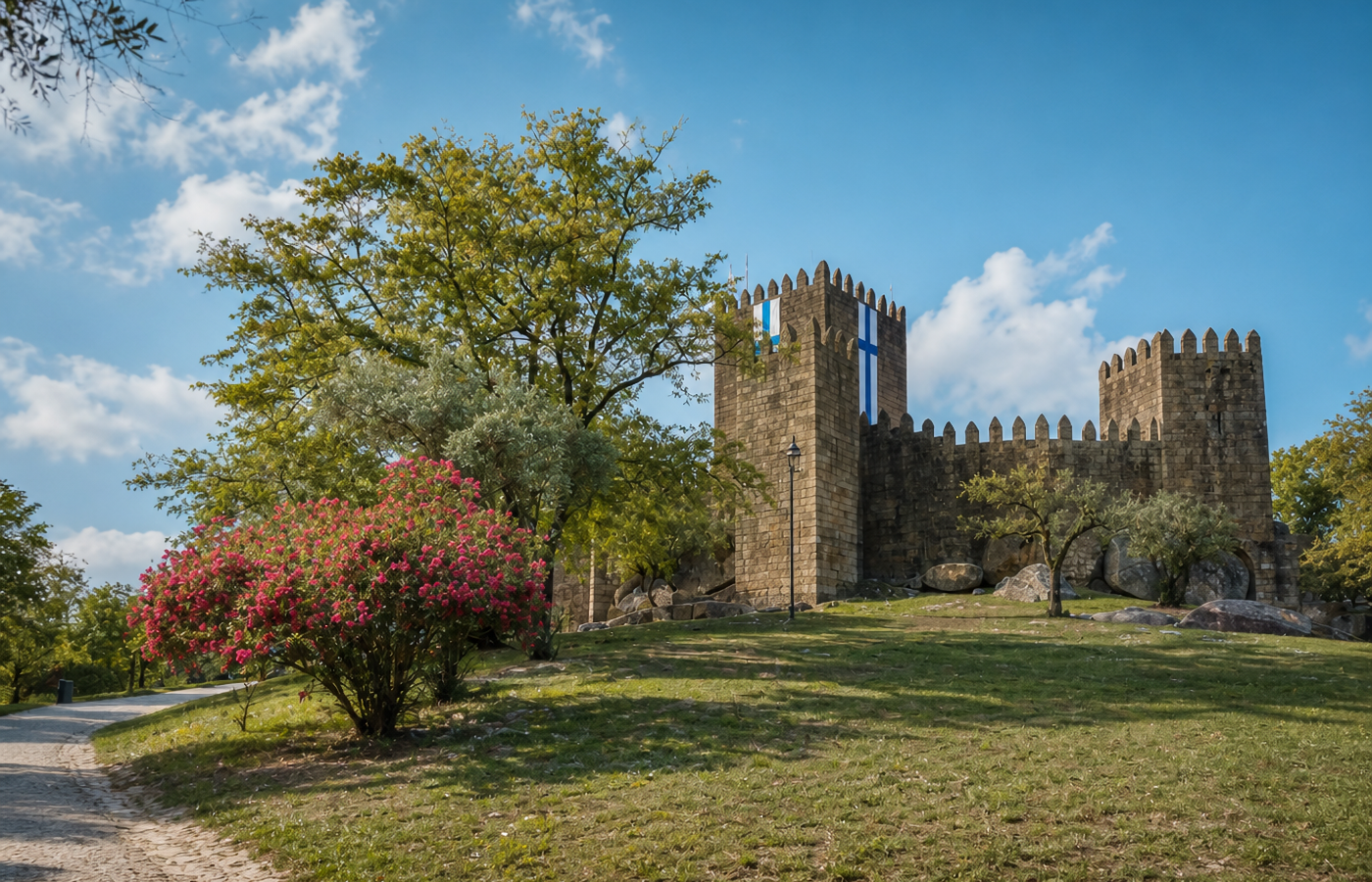
The Castle
The 10th century granite fortress stands as the rugged symbol of Portuguese origins, rising above the city as both guardian and political cradle. Commissioned by Countess Mumadona Dias, a powerful noblewoman governing under the Kingdom of León, the stronghold was part of a deliberate strategy. She founded the Monastery of Santa Maria in the valley below and built this fortress above to protect it from Viking raids.
Though Mumadona built the fortress to secure her lands, she also laid the foundation for what was to come. When the County of Portucale later passed to Teresa of León and Henry of Burgundy, the stage was set for their son, Afonso Henriques, who transformed this stronghold into a political center and became Portugal’s first king.
Climb the stone stairs to the battlements and walk the entire perimeter. To the south, look for the sea of red brick chimneys crowning the Palace of the Dukes. To the north, the Sanctuary of Mount Penha rises above the mountain. Inside the Keep, or Torre de Menagem, a small museum traces the castle’s evolution from Mumadona’s original wooden fort to the Romanesque stone fortress seen today.
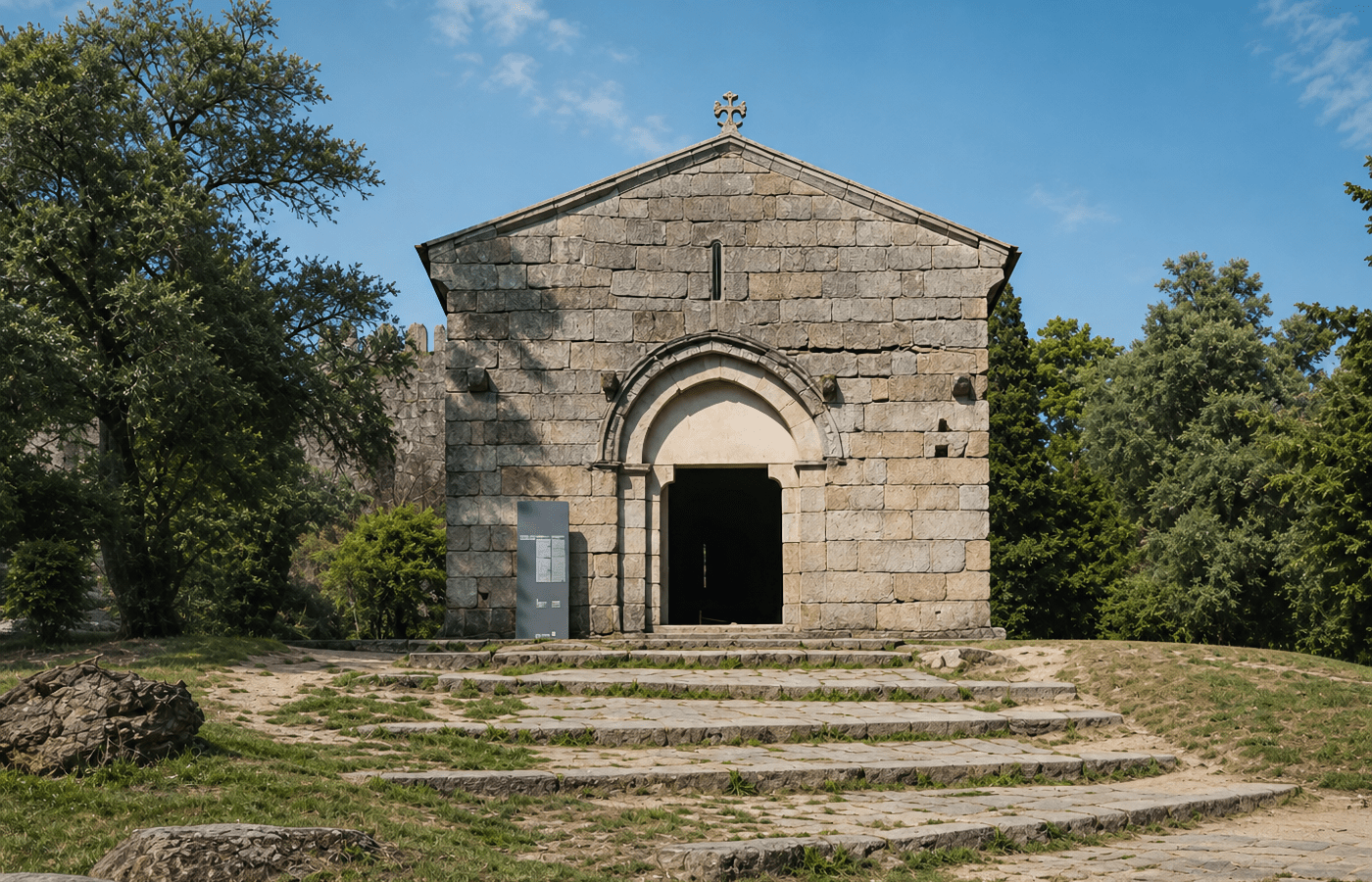
Chapel of São Miguel
As you descend from the Castle toward the Palace, you cross the historic green expanse between the two monuments. Tradition holds this to be the site of the pivotal Battle of São Mamede in 1128, where Afonso Henriques defeated the forces of his mother, Teresa of León, and later became Portugal’s first king.
Along the way stands the Chapel of São Miguel do Castelo, a small granite structure easy to overlook yet deeply tied to Portugal’s origins. Dating to the 12th century, it is traditionally believed to mark the site where Afonso Henriques, Portugal’s first king, was baptized.
Inside the chapel, ancient stone slabs cover the graves of warrior nobles who fought for the early monarchy. At the far end sits a simple chalice shaped stone basin which, according to long standing tradition, was used for the baptism of Afonso Henriques.
Before leaving, notice the narrow openings in the thick granite walls. More slit than window, they hint that this chapel served not only as a place of prayer, but also as a refuge in uncertain times.
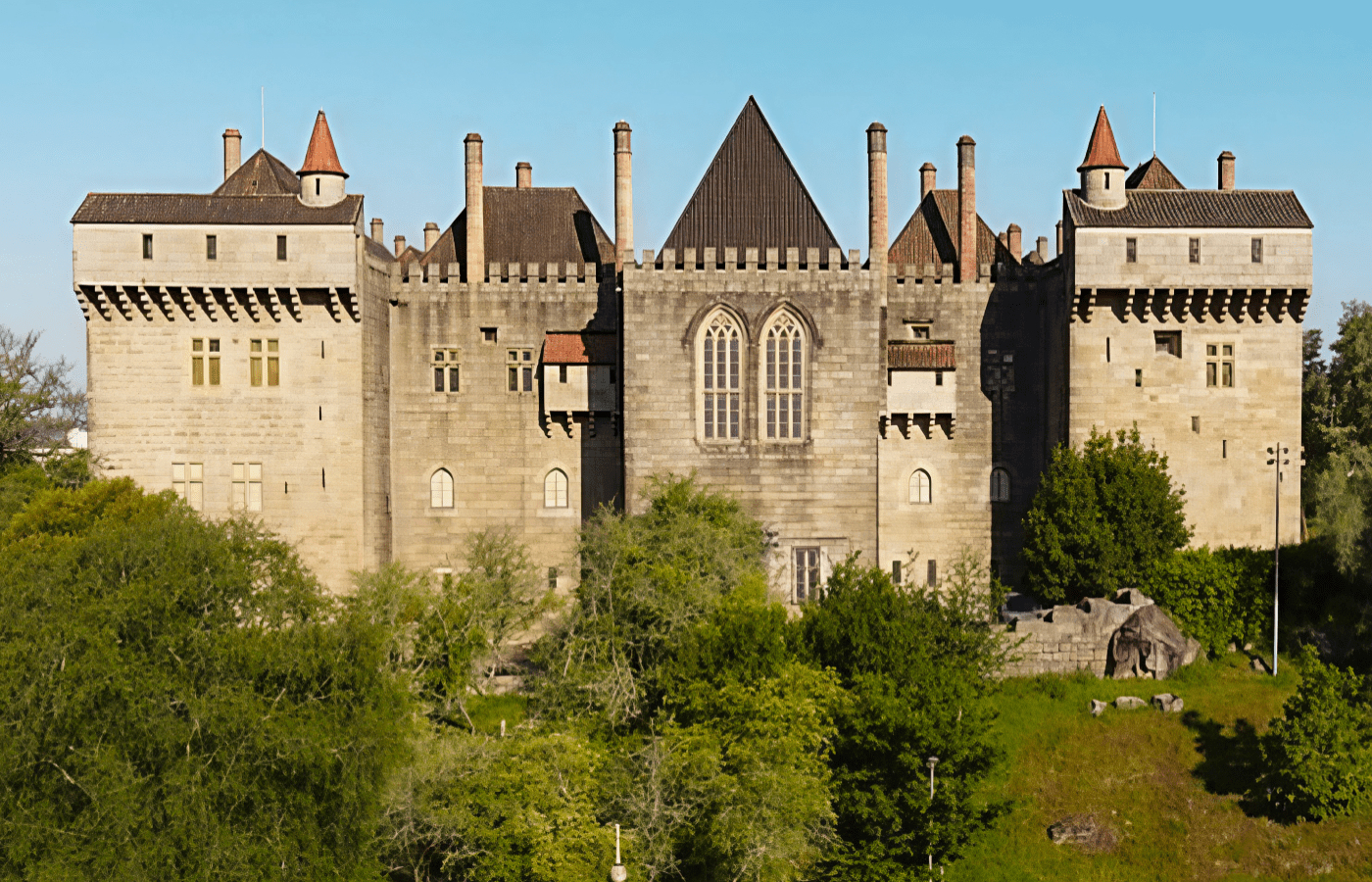
Palace of the Dukes of Bragança
As you walk from the Chapel toward the Palace gates on the Colina Sagrada, you move forward nearly 300 years in Portuguese history. The rugged world of Afonso Henriques, Portugal’s first king, gives way to an era of wealth, political power, and growing ambition. This palace was not built by Afonso Henriques. It was built in the 15th century by Afonso, 1st Duke of Bragança, a nobleman born centuries later who founded the powerful House of Bragança. The family would later claim Portugal’s crown in 1640, ruling Portugal and its global empire until the monarchy ended in 1910.
As you enter the courtyard, the palace rises into a forest of 39 brick chimneys, symbols of status and hospitality. Inside the Great Hall, soaring wooden ceilings resemble inverted ships built using techniques similar to naval construction. In the chapel, colorful Flemish stained glass offers a vivid contrast to São Miguel’s austere granite. Before leaving, take a moment to admire the Pastrana Tapestries, whose richly detailed scenes bring Portugal’s conquest of North Africa vividly to life.
Rua de Santa Maria
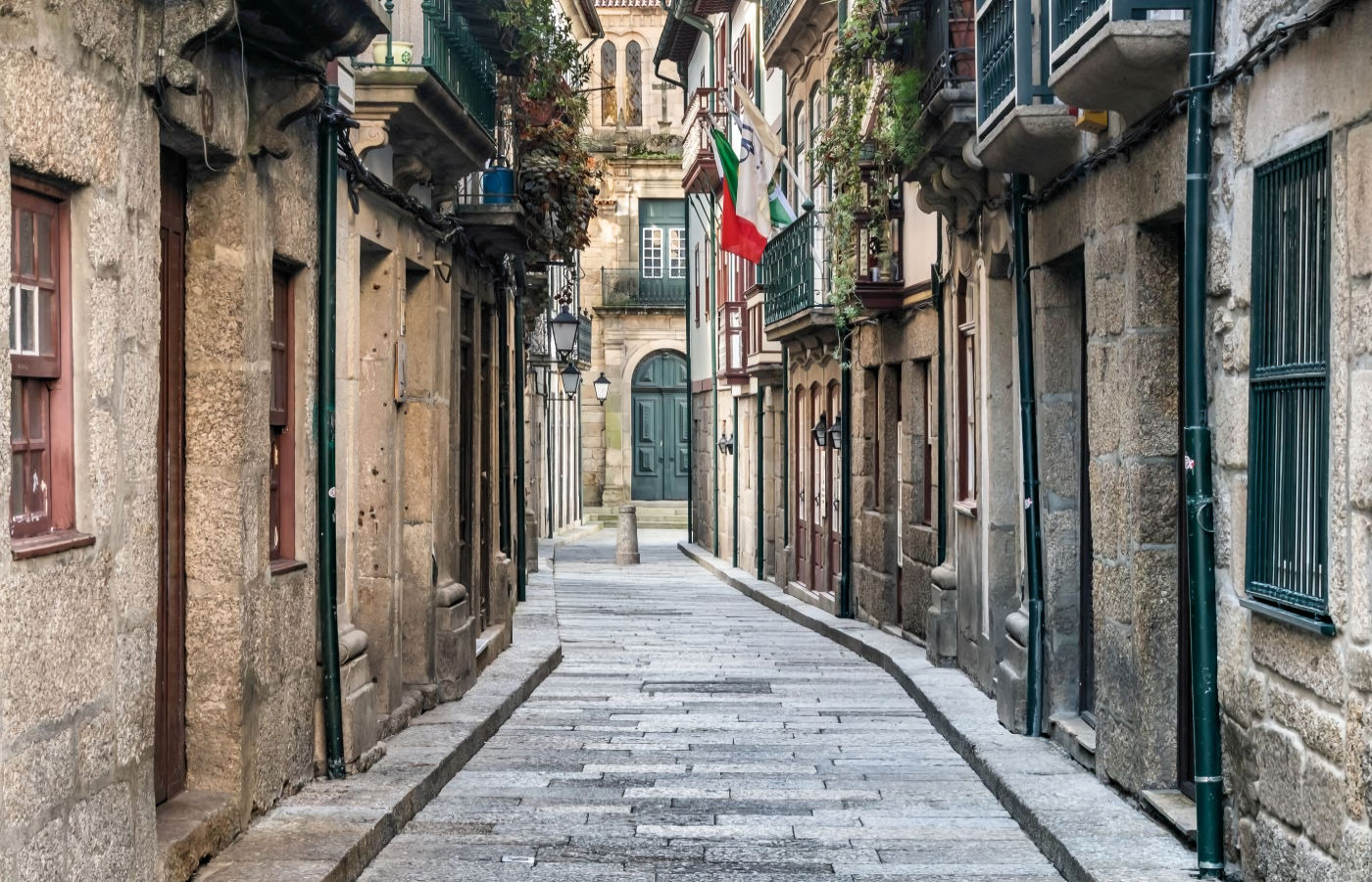
Rua de Santa Maria and Hotel da Oliveira
Leaving the wooded calm of the Colina Sagrada behind, the mood shifts almost immediately. At the park’s edge, the wide gravel path narrows into Rua de Santa Maria, the historic spine linking Guimarães’ early foundations to its growing civic heart.
In the 10th century, Countess Mumadona Dias commissioned this protected route to connect her castle with the monastery she founded in the valley below. While the original monastic buildings have long since evolved, their footprint remains at the heart of the Church of Nossa Senhora da Oliveira. Over time, the defensive passage evolved into the granite street you walk today.
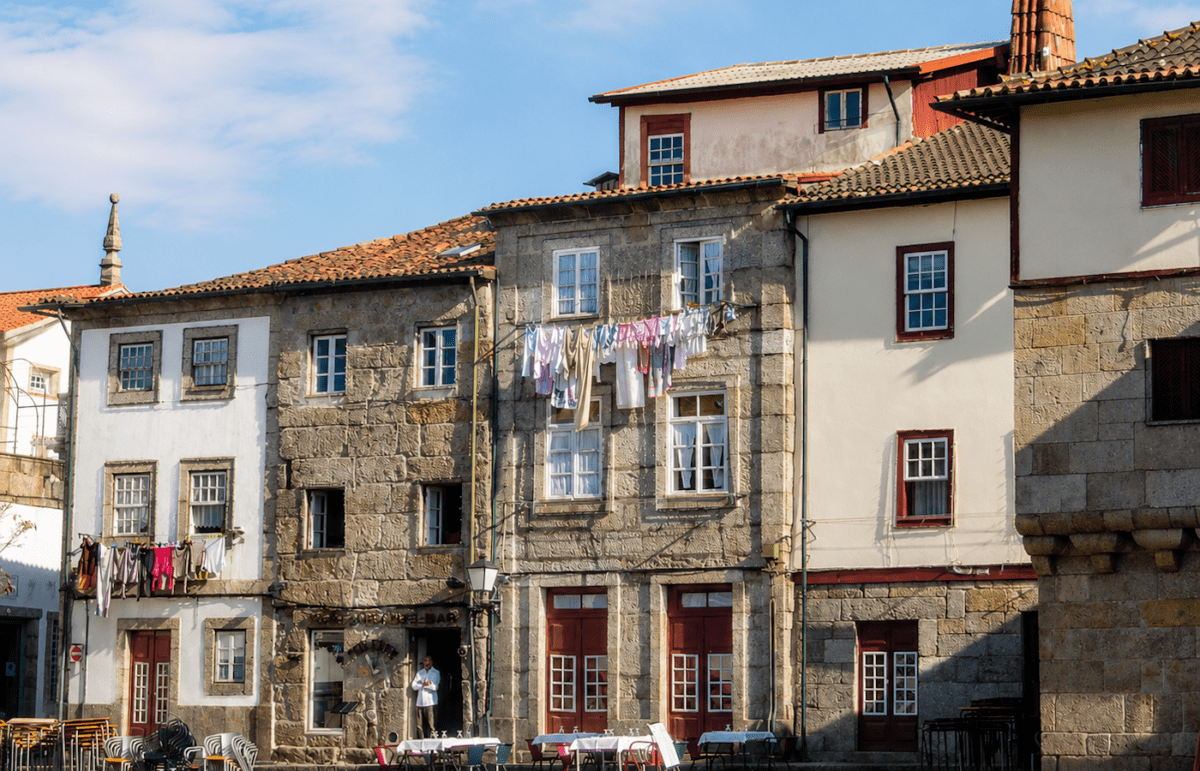
Today, Rua de Santa Maria wears its layered history openly. Gothic and Baroque façades rise shoulder to shoulder, their granite walls softened by wrought iron balconies spilling with flowers. Buildings lean gently inward, casting cool shadows across cobblestones polished by centuries of footsteps. Massive granite thresholds frame many doorways, while coats of arms, or brasões, remain etched into the stone, some intact, others worn by time, quiet reminders that prominence rarely lasts forever. About halfway down the street, the Antigo Convento de Santa Clara draws the eye upward. Once among the wealthiest convents in the region, it became known for the famous Tortas de Guimarães.
As the lane narrows, the city feels quieter and more enclosed. Then comes one of Rua de Santa Maria’s most recognizable sights, the arch of Casa do Arco spanning overhead. One side of the residence is believed to be the original medieval home of a noble family, while a later wing expanded across the narrow lane as the household grew. With little room to build outward, the two structures were joined by a stone arch, a practical solution that became one of the street’s defining images.
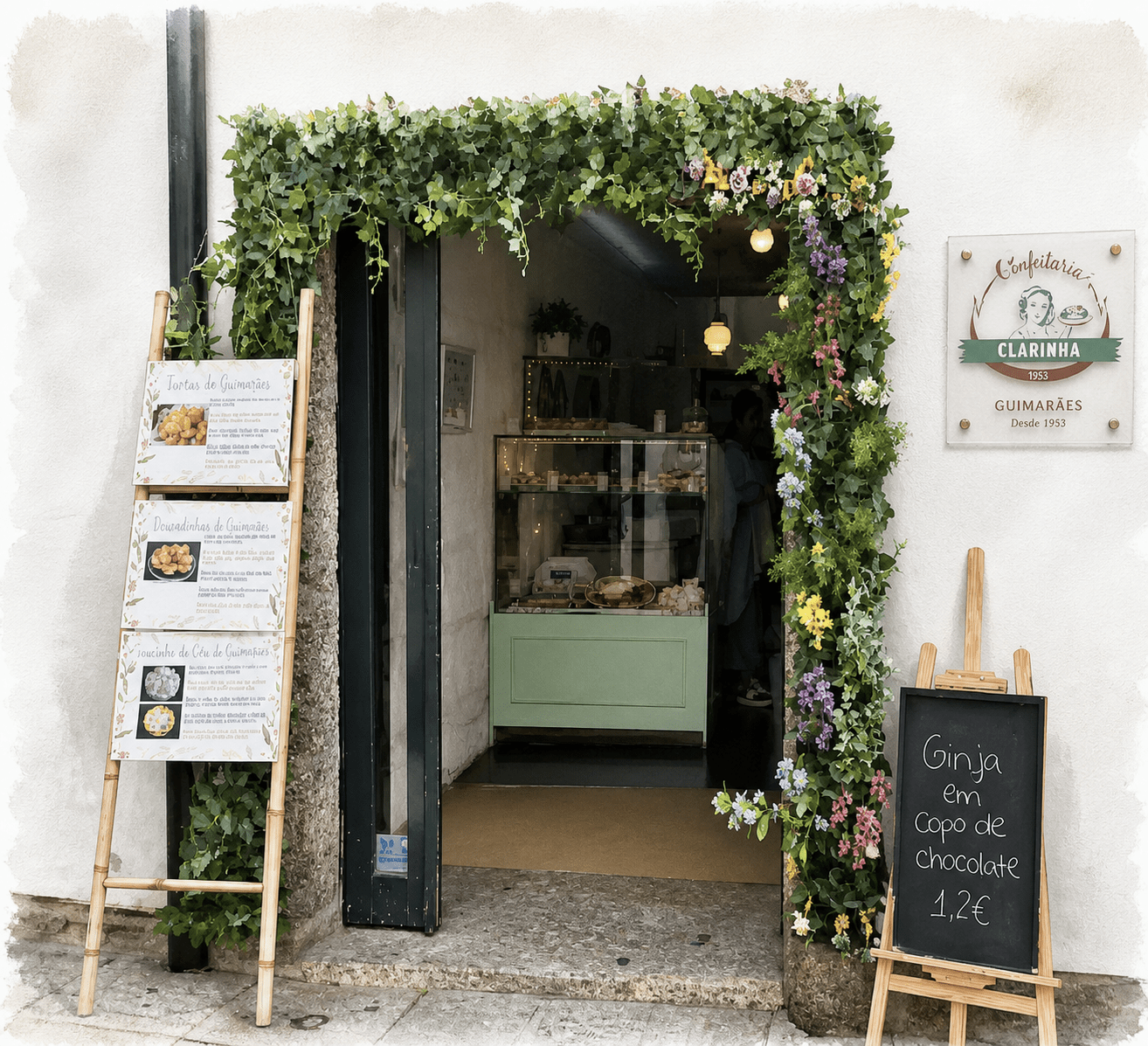
Pastelaria Clarinha, an inviting stop for local sweets and a galão
Pastries and the Arrival at Largo da Oliveira
Just beyond the arch, almost easy to miss, sits Pastelaria Clarinha (Divina Gula). Inside, glass cases display Tortas de Guimarães — handmade sweets filled with chila (squash jam), almonds, and eggs, rooted in convent tradition. Pausing for a galão (coffee with milk) and one of the city’s signature pastries, you taste the richness of egg yolk and almond echoing the story traced through stone.
A few steps farther, the buildings begin to recede and light widens overhead. Santa Maria Street opens into the broad expanse of Largo da Oliveira. Arcades frame the square, stone monuments anchor its center, and cafés spill into the open air. After the intimacy of the narrow lane, the space feels expansive and alive — a place where history no longer leans overhead but stands fully revealed.
Largo da Oliveira
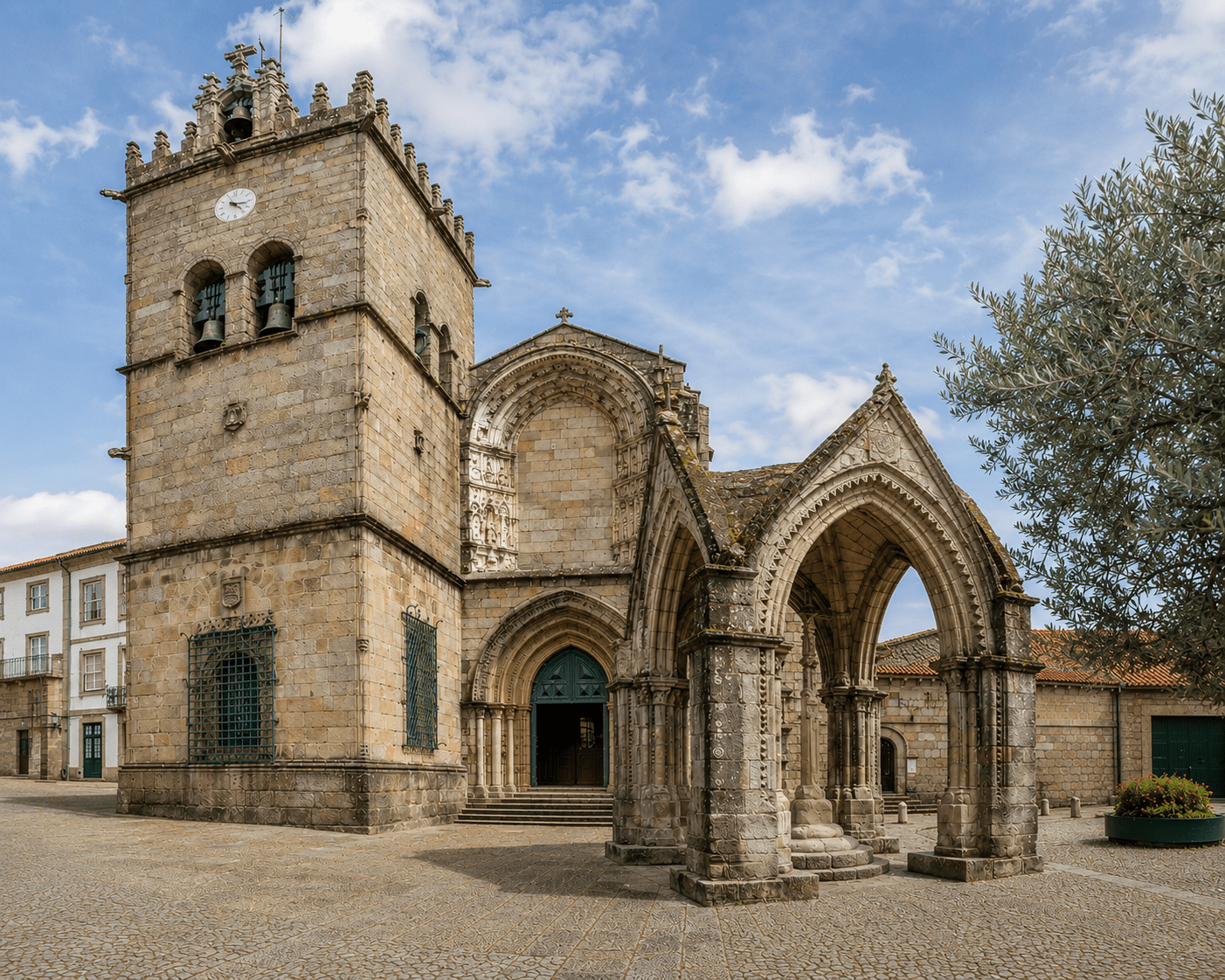
Largo da Oliveira, the Padrão do Salado, and the Olive Tree
At the end of Rua de Santa Maria, the city opens into a sequence of interconnected squares that form the historic heart of Guimarães. Here, the mood shifts from fortress and monarchy to everyday life, with arcaded walkways, wrought-iron balconies, and centuries of stories unfolding in the open air. Overlooking Largo da Oliveira, Hotel da Oliveira occupies one of the square’s historic buildings, placing visitors at the center of this remarkably preserved urban landscape. Though the walk between Largo da Oliveira and Praça de São Tiago takes only a few minutes, the transition feels much slower, like wandering through an outdoor gallery shaped by time.
At the center of Largo da Oliveira stands the olive tree that gave the square its name, recalling one of Guimarães’ most enduring legends. An earlier tree, planted to provide oil for church lamps, had withered into a barren trunk. In the 14th century, a merchant named Pero Esteves placed a granite cross beside it, and within days the tree miraculously sprouted new leaves, transforming the square into a place of devotion. King Afonso IV later enclosed the cross within the Padrão do Salado, commemorating his victory at the Battle of Río Salado and linking royal triumph with the people’s miracle. Yet despite the king’s grand monument, local memory remained fixed on the miracle itself. The Padrão became the frame; the olive tree remained the story.
Beside the square rises the Church of Nossa Senhora da Oliveira. Its origins date to 949, when Countess Mumadona Dias founded a monastery here for monks and nuns. Over the centuries, the site evolved as Afonso Henriques designated it a church in 1139, and following the Battle of Aljubarrota in 1385, King João I commissioned the Gothic structure seen today. Inside, you can still find remnants of the original 10th-century foundations, providing a direct link to the city’s earliest days.
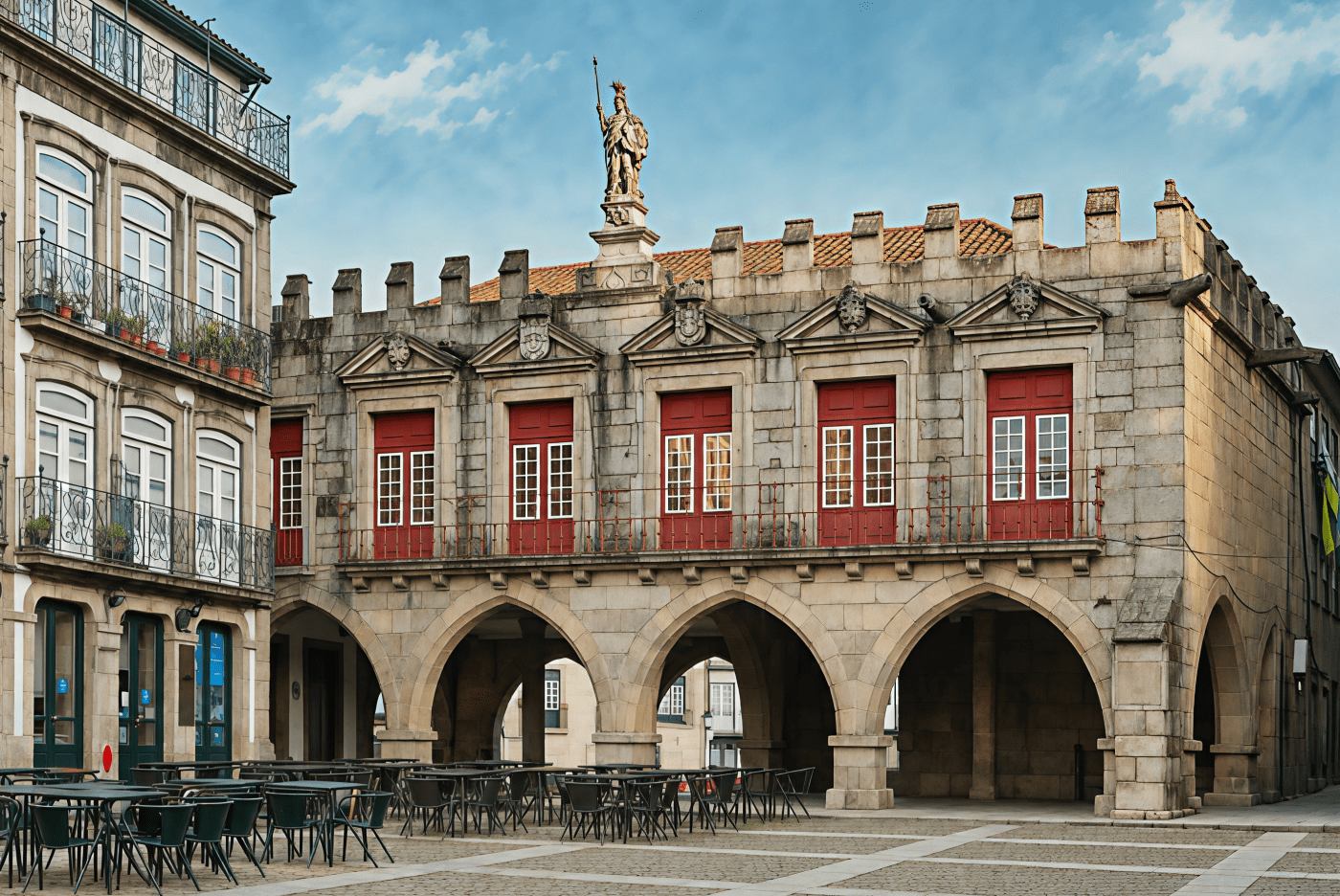
The Pilgrim’s Crossroads: Praça de São Tiago
Passing beneath the Gothic arches of the Old City Hall, known as the Antigos Paços do Concelho, you step into Praça de São Tiago, one of Guimarães’ most atmospheric squares. The open porch below once allowed people to pass directly through the building, while a stone warrior still stands watch above the façade.
Local tradition claims that Saint James (São Tiago) once placed an image of the Virgin Mary here, linking the square to early Christian devotion and the wider Camino de Santiago pilgrimage. History tells a different timeline, but the story endured. Centuries later, a small Chapel of Saint James was built for passing pilgrims before eventually being demolished in the 19th century. Today, its footprint still survives in the granite paving stones at the center of the square.
More than historical fact, the legend gave meaning to the space. By linking Guimarães to Saint James and the great pilgrimage routes of Europe, Praça de São Tiago became more than a marketplace. It became a place shaped by story, faith, and belonging.
Toural + Leather District
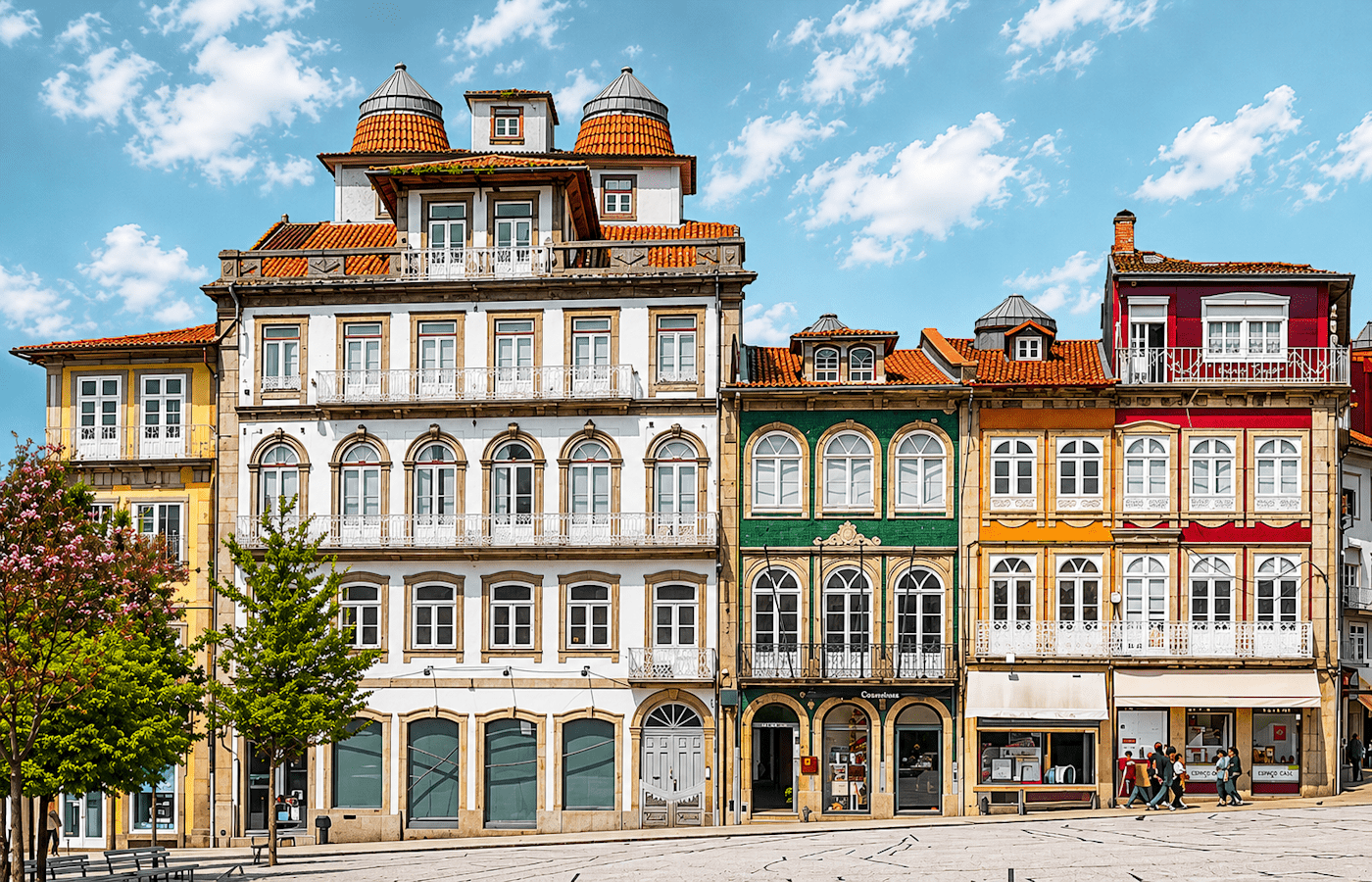
Largo do Toural: The Grand Stage of the City
Stepping out from Guimarães’ narrow medieval streets, the city suddenly opens wide. Largo do Toural was once a muddy field beyond the old walls where cattle markets, fairs, and early bullfighting unfolded. By the 18th century, the busy fairground had gradually transformed into an elegant civic square lined with refined façades. Today, symmetrical buildings and blue-and-white tiled façades frame the open space, while a central fountain anchors the square.
At the far end near Alameda Garden stands the Torre da Alfândega, the last surviving defensive tower of Guimarães’ medieval walls. It was once used to inspect and tax goods entering the city. It later gained the famous “Aqui Nasceu Portugal” (“Portugal Was Born Here”) inscription, transforming it into a lasting symbol of national identity.
In August, during the Festas Gualterianas, the square fills with lights, music, and celebration. Once a place of markets and public spectacles, Largo do Toural is now a civic square where people gather, sit, and celebrate life.
Before leaving Toural behind, stop at an ATM if you are low on cash. There are no ATMs on Monte Penha, and many local spots remain cash only.
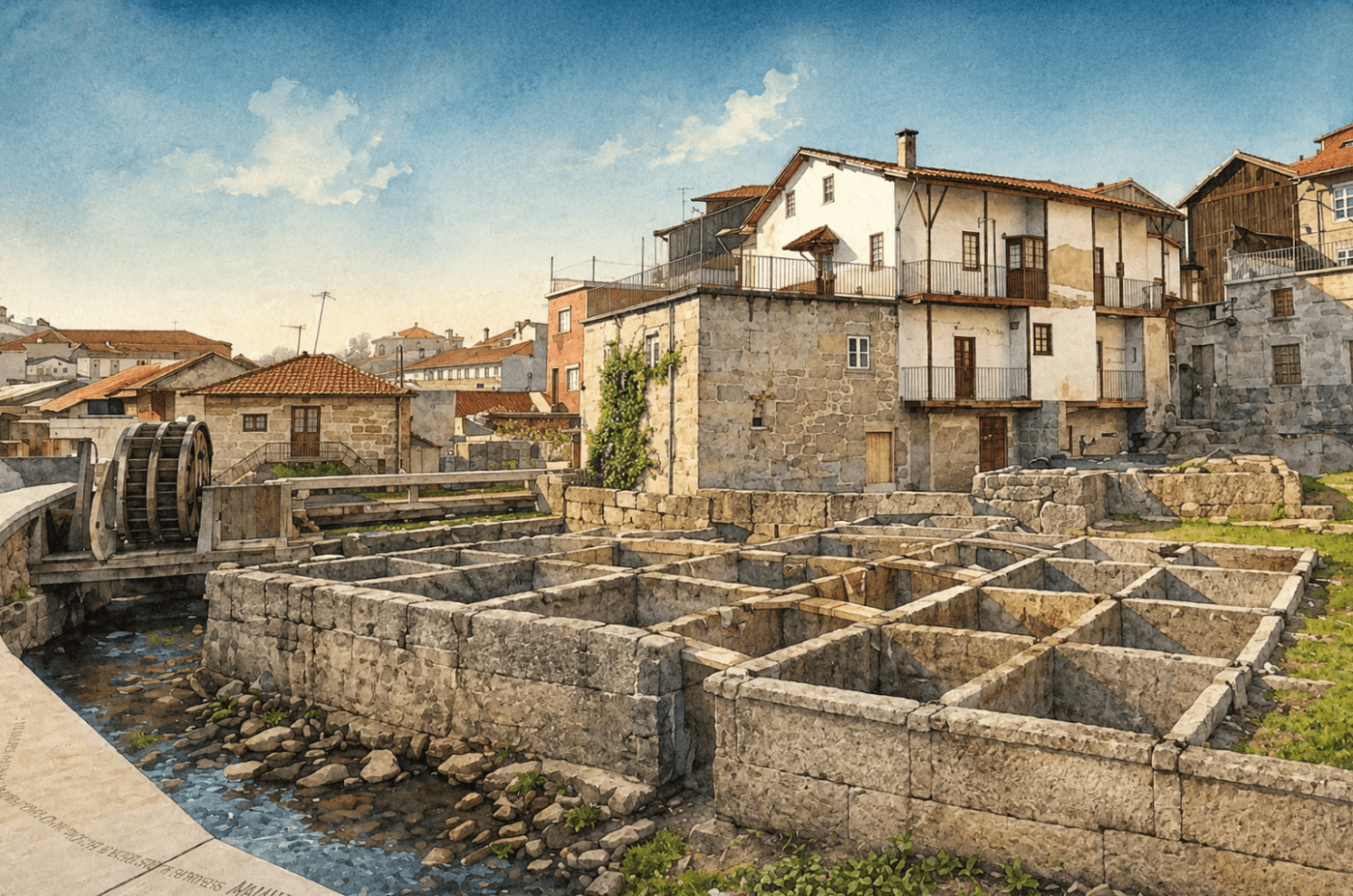
A grid of ancient stone tanks once used for soaking animal hides in tannins
Pits to Prayers: The Crescent of Couros
From Largo do Toural, the Alameda de São Dámaso Garden leads downhill into the Zona de Couros, Guimarães’ historic Leather District. Nearby, Rua de Couros marks the descent into a valley shaped by one of the city’s oldest industries.
Guimarães became a tanning powerhouse because three essential resources converged here: water from the Couros River, tannin rich oak bark from nearby forests, and a steady supply of animal hides from the cattle market at Toural. For centuries, the hillside functioned like a vertical production line. Livestock was sold above, and hides transformed into leather below.
As you descend into Couros, traces of the old world remain. Granite tanning pits and sunken vats line the ground, while narrow stone channels once carried diverted river water between workshops. Much of the Couros River now flows underground, though parts of its engineered system still survive in the stoneworks around you.
By the 19th century, production expanded into large scale industry, and during both World Wars Guimarães supplied leather for boots, saddles, and belts. But prosperity came at a cost. Pollution from more than eighty tanneries poisoned the river, and as synthetic materials spread in the 20th century, the traditional stone pits gradually fell silent.
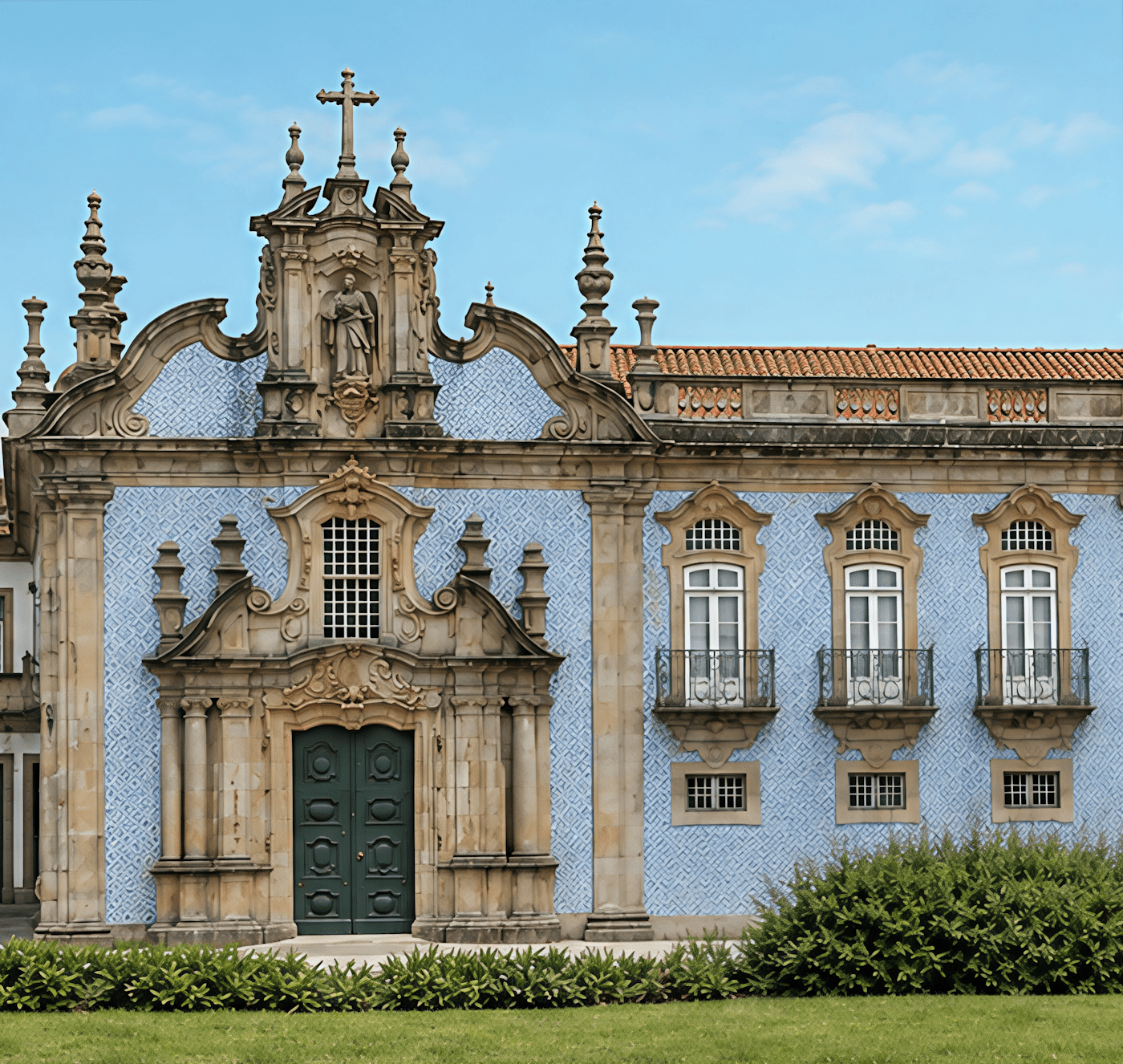
Franciscan brotherhood hall displaying blue-and-white azulejos
The Ascent: The Franciscan Sentinel
From Largo da Cidade, Rua de São Francisco climbs back toward the Alameda Garden. Rising to the left stands a striking Franciscan complex, marking the transition from the industrial valley below to the spiritual city above.
The Igreja de São Francisco anchors the ensemble with its granite Gothic form and pointed arches, while the neighboring Venerável Ordem Terceira adds a distinctly Portuguese layer, its façade wrapped in blue and white azulejos. Extending beyond, the convent wing and cloisters hint at the scale of the Franciscan community that once overlooked the tanning district below.
Campo da Feira + Santos Passos
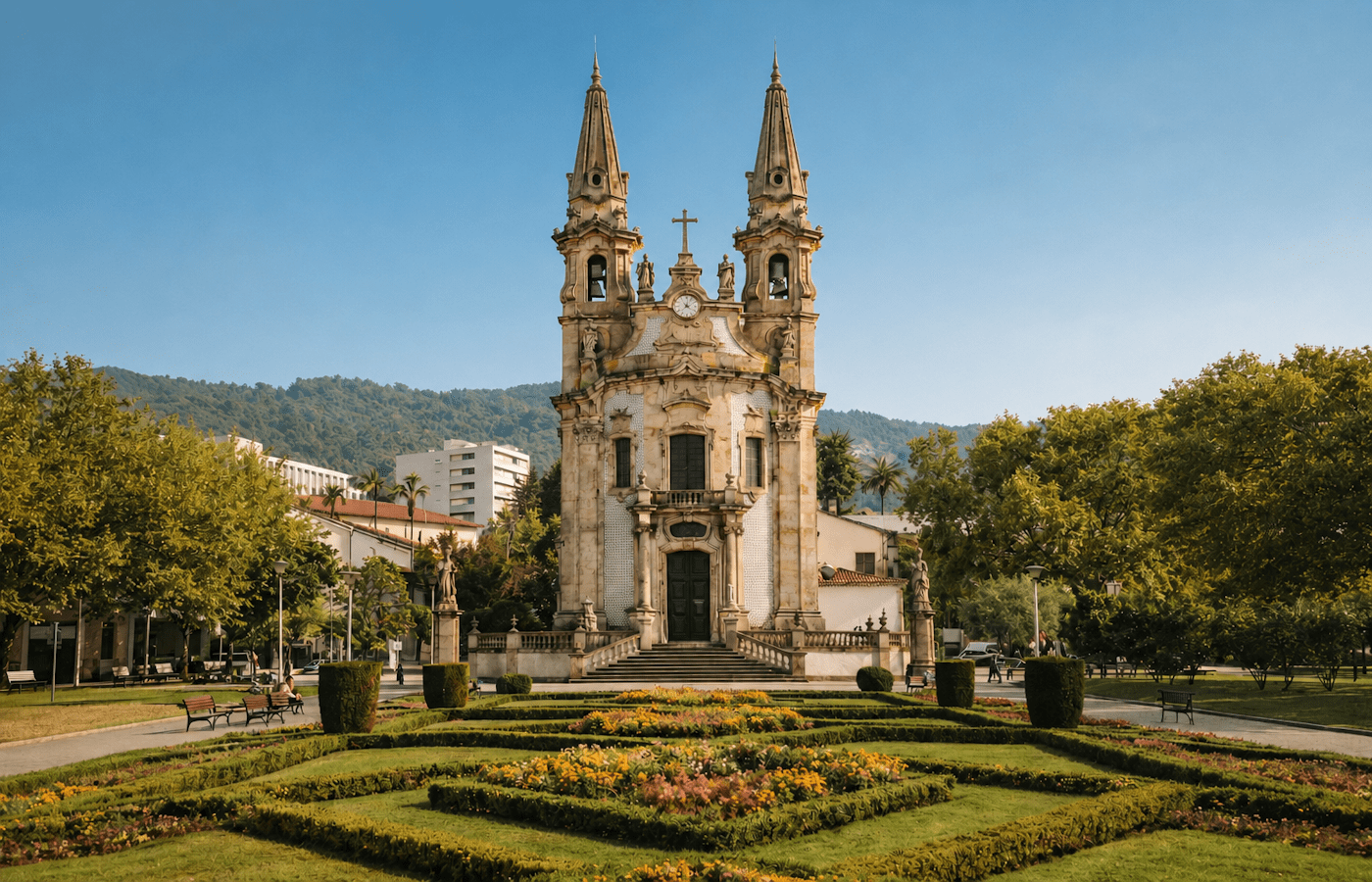
Leaving the Franciscan complex behind, the gardens of Campo da Feira unfold in perfect symmetry toward the Church of Santos Passos, creating one of Guimarães’ most iconic views. Once a bustling fairground beyond the medieval walls, this space was transformed into a formal garden in the nineteenth century, linking the city’s past with its quieter present.
The twin azulejo-clad towers of Santos Passos rise against the backdrop of Mount Penha, drawing the eye upward toward the final chapter of the journey. Just beyond, the Teleférico da Penha carries visitors from the historic streets below to the granite heights above, a fitting transition from the story of the city to the landscape that watches over it.
Mount Penha
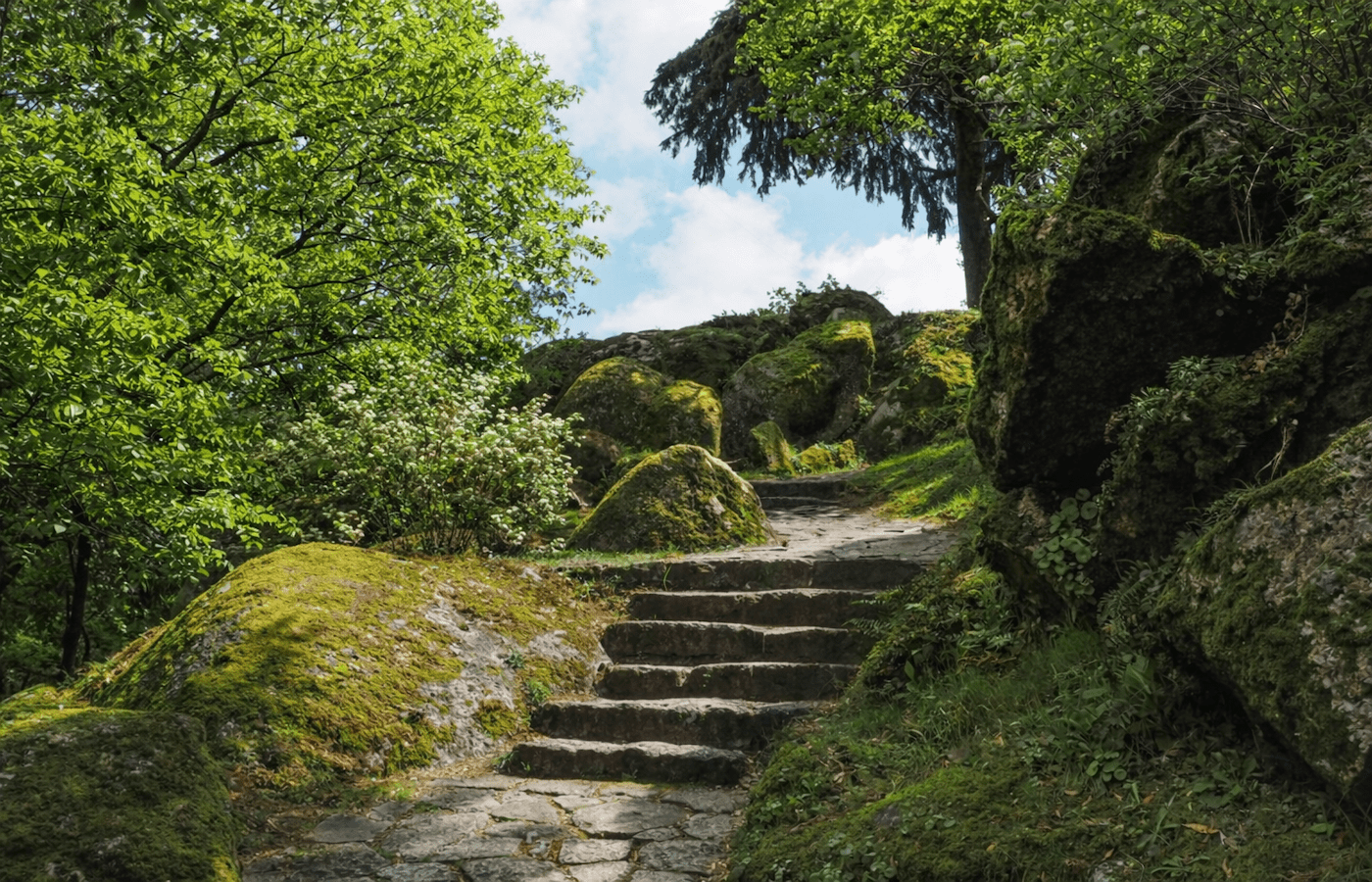
Granite steps leading into the mysterious labyrinth
When you have only one day in Guimarães, spending three hours on Monte Penha can seem difficult to justify. Yet the mountain offers something the historic center cannot: silence, scale, and a landscape shaped by both stone and faith. This first loop explores the foundations of Penha, where geology and devotion meet among the rocks.
The First Loop: Ancient Foundations
Pope Pius IX ↗
The 1893 monument commemorates Pope Pius IX’s proclamation of the Dogma of the Immaculate Conception in 1854, a milestone that helped establish Penha as an important pilgrimage destination.
Capela de Santa Catarina ↗
Built in 1601, this is the oldest surviving chapel on the mountain. Its simple stone walls recall an earlier Penha, when the slopes were gradually evolving from lookout to sanctuary.
Mitre Rock ↗
Named for its resemblance to a bishop’s ceremonial headpiece, this distinctive granite formation was slowly shaped by wind and water, creating the delicate hollows known as tafoni.
Gruta de Nossa Senhora de Lourdes ↗
Nestled among the rocks, this small Marian grotto reflects Penha’s enduring connection to pilgrimage, healing, and quiet devotion.
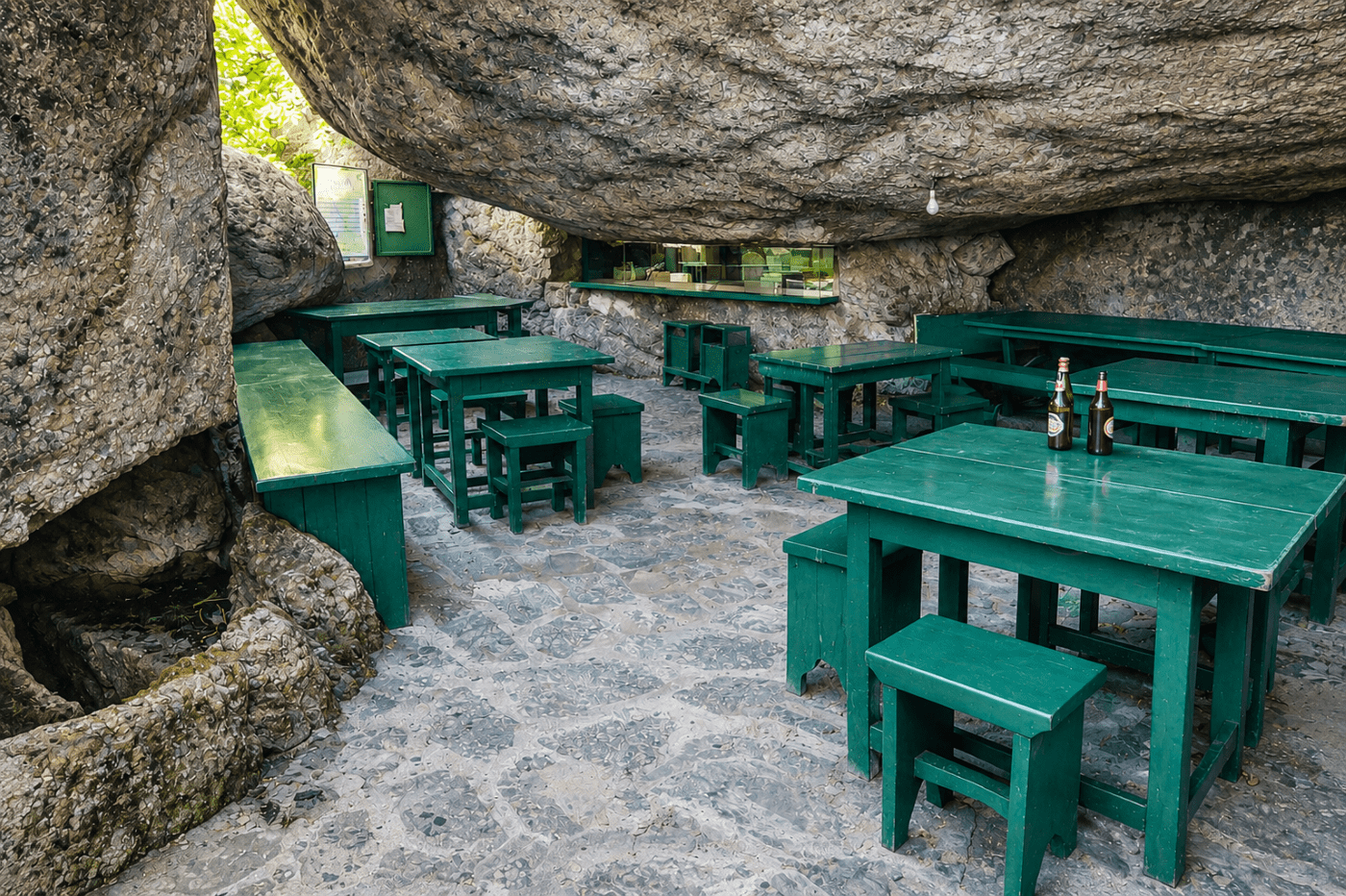
Dining beneath the granite at Adega do Ermitão
The Second Loop: The Hermit’s Path
Over time, Monte Penha became a place of pilgrimage and solitude. Hermits sought refuge among the granite outcrops while pilgrims climbed the mountain in search of reflection. This loop follows that quieter story through hidden chapels, narrow stone passages, and landscapes shaped by both faith and geology.
Adega do Ermitão ↗
Built into the rocks, the “Hermit’s Cellar” recalls the mountain’s long connection to those who lived among its granite slopes. Today it serves rustic barbecue, vinho verde, and traditional Minho dishes in a relaxed outdoor setting. Cash only (euros).
The Serpent & the Labyrinth ↗
A maze of narrow granite corridors twists between towering boulders, forming one of Penha’s most memorable landscapes. Moss covered stone, hidden grottos, and unexpected openings make it easy to understand why hermits once sought solitude here.
Gruta-Ermida de Nossa Senhora do Carmo ↗
Carved into the granite, this chapel became the sanctuary of Guilherme Marino, a hermit who arrived from Rome in 1702. Inside, an 18th-century sculpture of the Virgin Mary stands beside the stone shelf where Marino is said to have slept for nearly thirty years.
Capela de São Cristóvão ↗
Perched among the granite outcrops, this small chapel once served as a symbolic guardian for pilgrims. Its hillside setting offers sweeping views across the valley below.
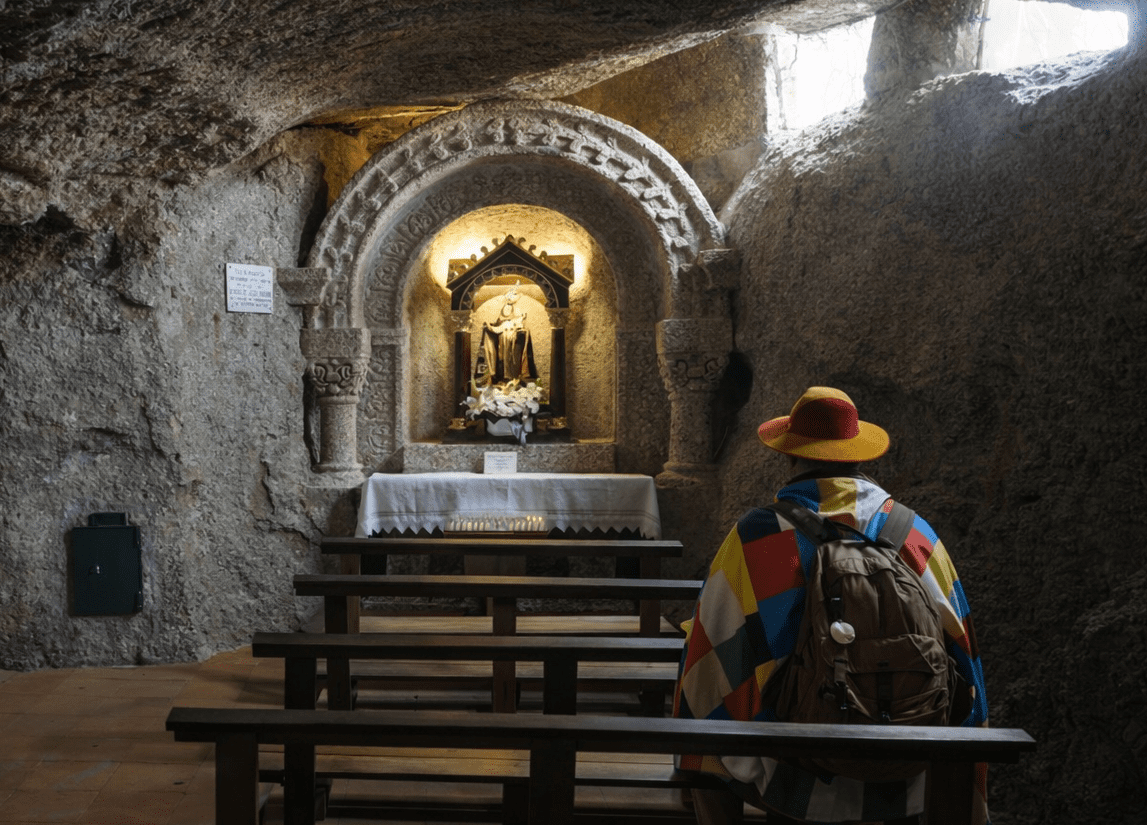
Pilgrim reflecting on those who have come before— AI-enhanced image
The Grand Finale
The final stretch brings you to the landmarks that define Mount Penha’s skyline, where granite, faith, and sweeping views come together.
Hotel da Penha / Monastery ↗
Historically linked to the Augustinian order, this stone complex now operates as a distinctive historic hotel. Its commanding presence reflects Penha’s long tradition of refuge and hospitality.
Aviators’ Monument & the Wobbling Boulder ↗
The airplane-tail-shaped monument honors aviation pioneers, while the nearby wobbling boulder offers a reminder that Penha’s granite landscape can still surprise.
Sanctuary of Penha ↗
Designed by José Marques da Silva, the Sanctuary of Penha is the mountain’s architectural centerpiece. Built from local granite, its Art Deco design rises naturally from the surrounding landscape, bringing together faith, architecture, and geology high above the city.
RELATED STORIES