Norte Region
Cradle of Portugal
To understand Portugal, you must begin in the North. While Lisbon may be the country’s vibrant face to the world, the Norte Region remains the enduring pulse. It is elemental, storied, and profoundly rooted in the nation’s origins. The Norte Region is the ‘Cradle’ from which a kingdom was chiseled in granite, faith, and green valleys. It is the ultimate destination for those seeking to touch the foundations of Portuguese identity — a landscape alive with tradition that has not merely survived, but lived, century after century.
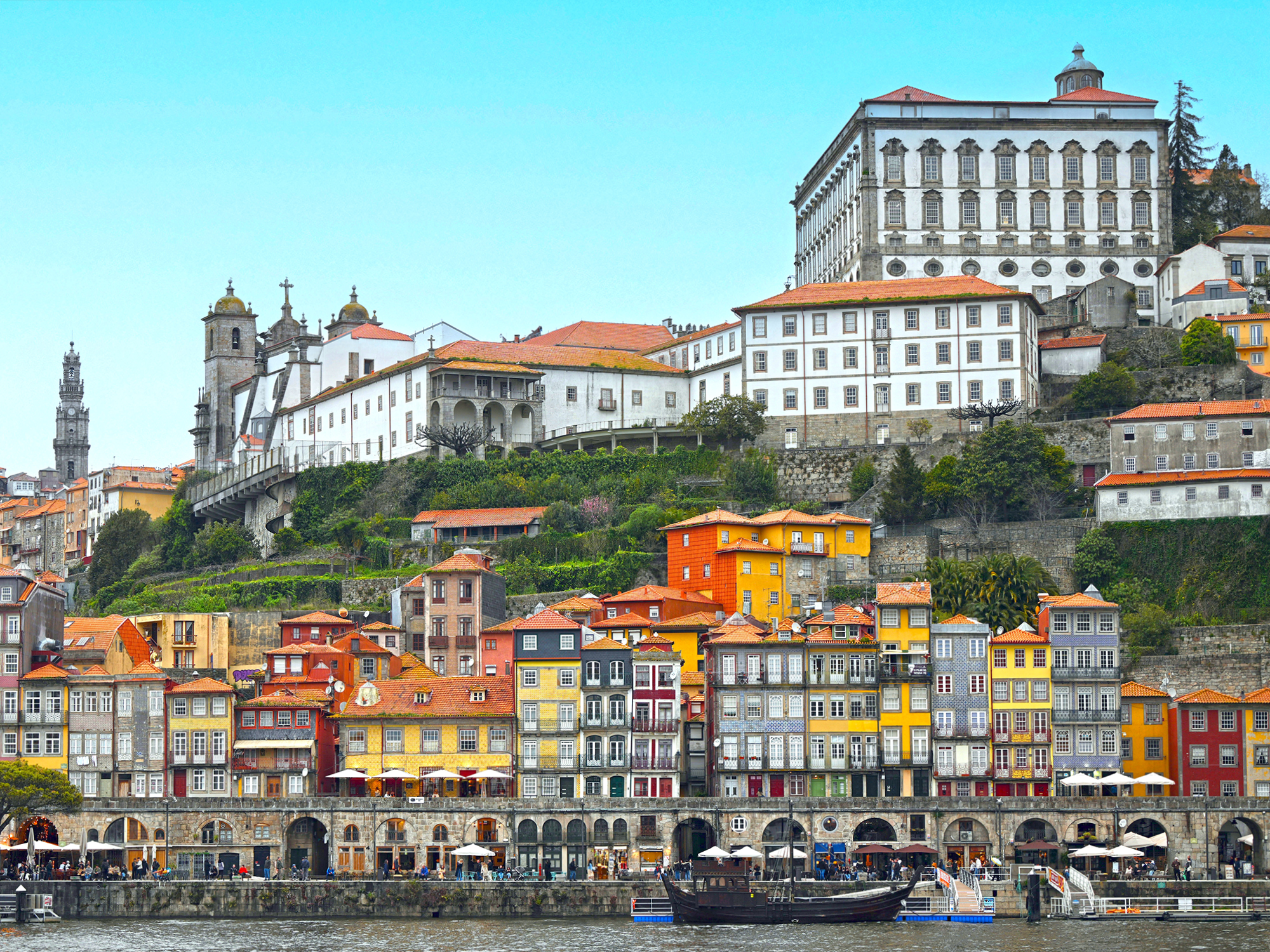
Colorful Ribeira district in Porto, Portugal
Porto and the Douro River Valley of Gold
Our story begins where the Atlantic meets the river in the legendary city of Porto, before winding inland through the Douro River Valley. For millennia, people and nature have worked together to sculpt this landscape. The valley is both a UNESCO World Heritage site and the world’s oldest demarcated wine region, established in 1756 by the Marquês de Pombal to protect one of the world’s earliest wine brands.
A Moment on Portugal’s Most Beautiful Road
The N222 is legendary for a reason. The 27-km stretch between Peso da Régua and Pinhão is pure magic, winding along the Douro through steep vineyard terraces. Driving it made me long for my motorcycle and the freedom of two wheels.
The first village that caught my attention was Rede. I am driving — road curving, river beside me — when a vintage-looking building appears ahead with Rozès written across its side. I wind down a narrow street, cross the tracks, and park beside the river. A footpath runs along the rails, so camera in hand, I follow it, watching for trains while searching for the right angle.
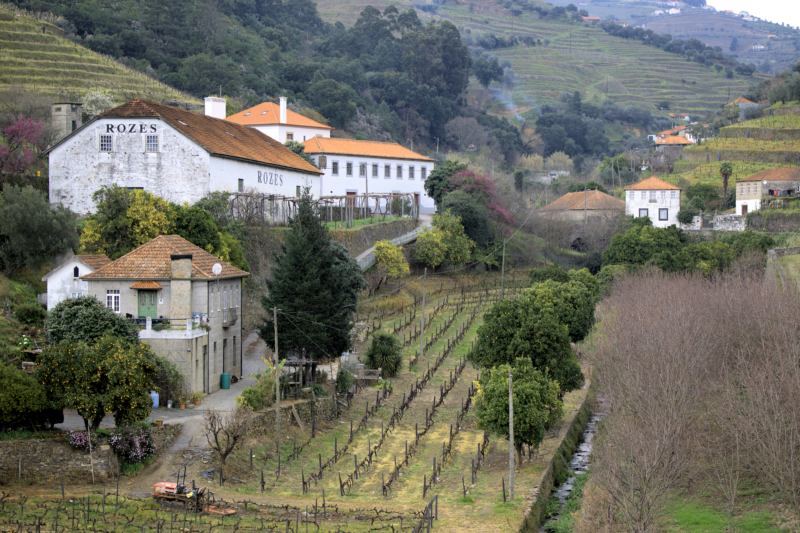
On my way back, I notice a weathered man leaning against an old truck smoking. I stop to talk. He tells me the building belongs to a historic Port house founded in the mid-1800s. The wines are aged and blended in Vila Nova de Gaia, Porto, while their vineyards and production facilities are located further upriver in the Douro region. Quinta Monsul in nearby Cambres serves as their main vinification site. The name remains here, he says, because the building is part of a historic quinta tied to the company’s legacy. I thank “Luca” for the story.
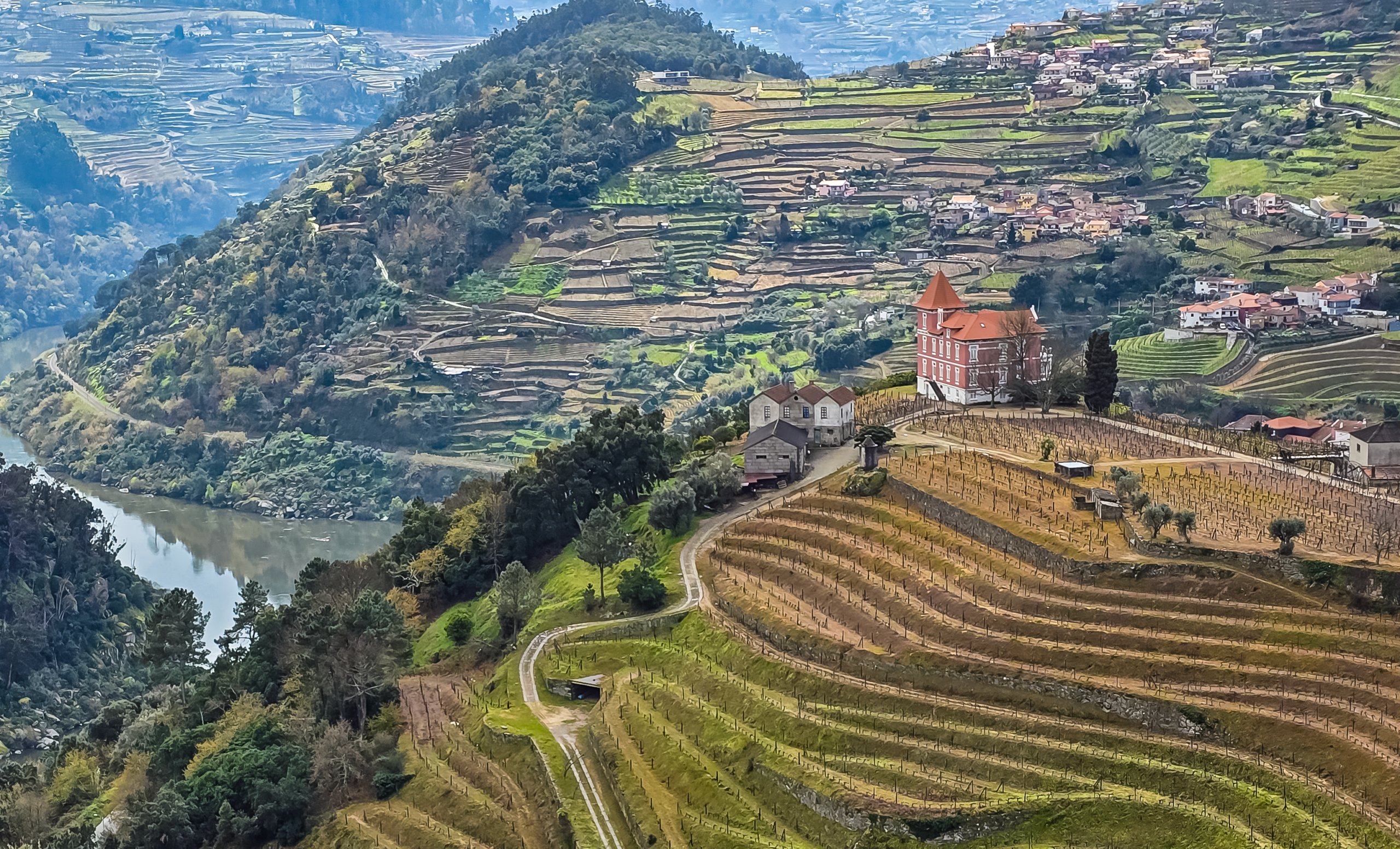
Later along the N222, the valley opens — vineyards cascading like green staircases toward the river. It takes twenty minutes to find a safe place to stop, but when I do, I stand there with goosebumps, camera in hand, glad I paused.
Time to move on. Porto is calling, and I wonder what waits around the next bend.
Porto Highlights
- Ribeira District
Wander through the colorful, narrow alleys of this iconic waterfront district. - Dom Luís I Bridge
Walk across the iconic iron top deck for the most famous panoramic view of the river and the city skyline. - Ancient Vineyards
Experience the breathtaking UNESCO-listed slopes where generations of farmers hand-carved the granite earth into the world’s first official wine region.
Forging a Nation: Guimarães and Braga
From Porto’s riverbanks, the journey continues into the architectural, political, and spiritual foundations of the nation in Guimarães and Braga. Across these cities, medieval castles and sacred spires recount a young king’s defiance and a nation’s birth.
While Guimarães provided the steel for this rebellion, Braga served as its spiritual and historical heart. Long before the foundation of the kingdom, from the time of Emperor Augustus, the city flourished as the Roman capital of the province of Gallaecia. Its heritage as a center of power gave the city a prestige that endured for centuries.
Guimarães Highlights
- Parque do Castelo e Paço dos Duques de Bragança
A monumental complex on a prominent hill that includes Guimarães Castle and Palace of the Dukes of Bragança. - Guimarães Historical City Centre
A UNESCO World Heritage site known for its perfectly preserved medieval layout, narrow cobblestone streets, and traditional wooden-balconied houses that date back centuries. - Monte da Penha
The mountain park overlooking the city, accessible by the Guimarães Cable Car, featuring walking trails, massive granite formations, and the Sanctuary of Penha.
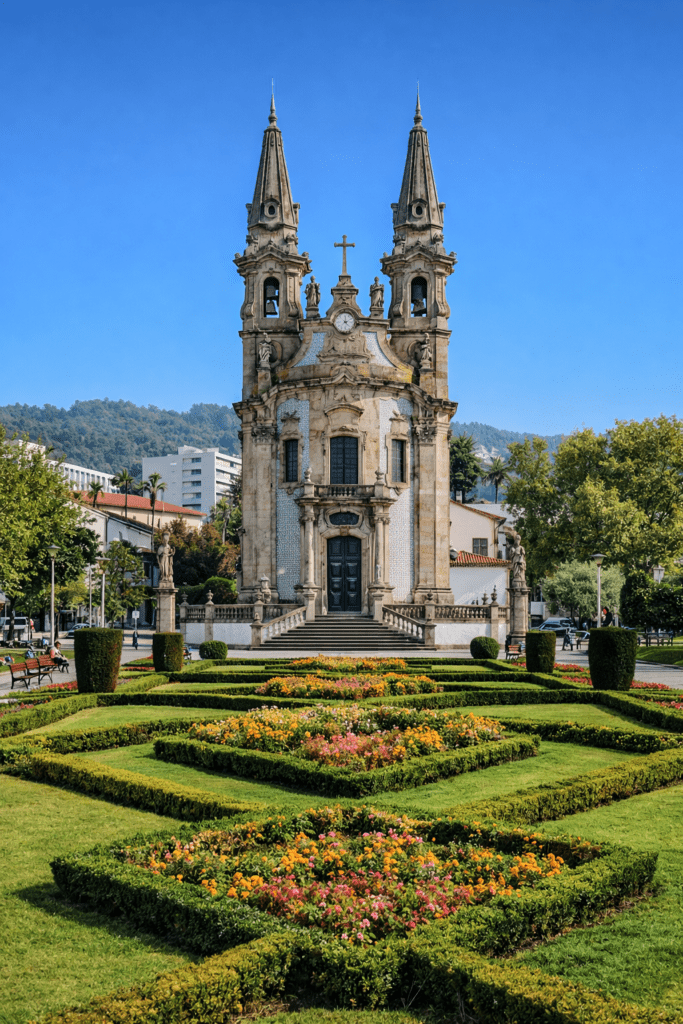
Braga Highlights
- Bom Jesus do Monte
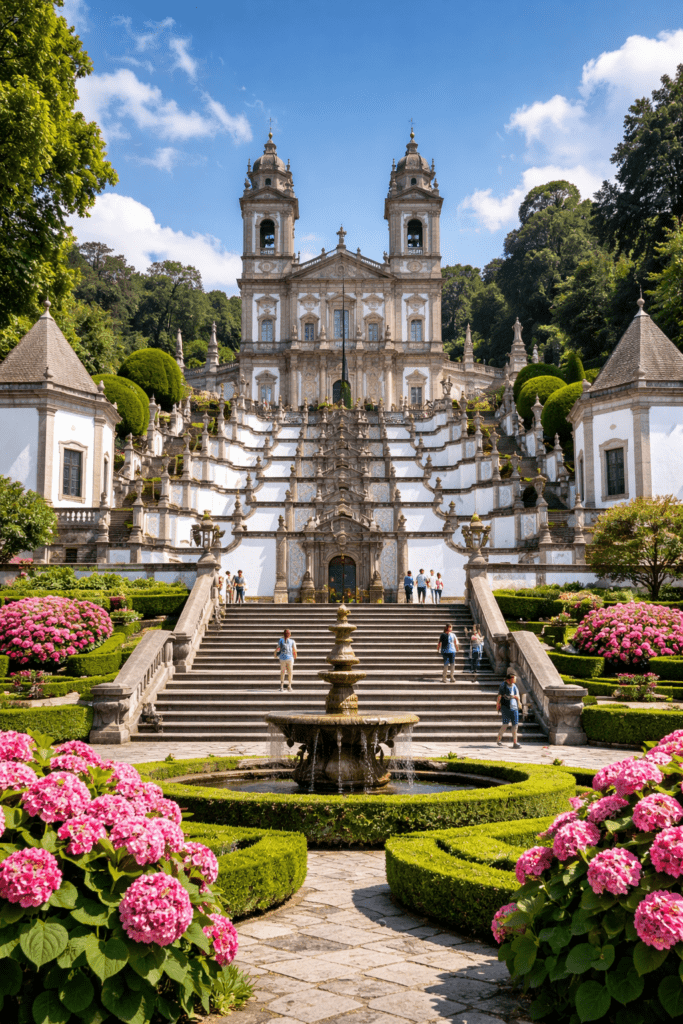
This UNESCO World Heritage site is famous for its striking 577-step Baroque staircase that zigzags up a hillside, representing the Stations of the Cross. At the top sits a neoclassical sanctuary, and a historic water-powered funicular is also available for access. - Braga Cathedral
The oldest cathedral in Portugal, founded in the 11th century. Blending Romanesque, Gothic, and Baroque styles, the cathedral holds significant historical importance as the seat of the country’s first bishops. - Praça da República
Also known as “Arcada,” this bustling square is the heart of civic life in Braga. It is a central meeting point featuring historic cafés, open-air seating, and distinctive arcaded buildings.
Exploring Portugal’s Peneda-Gerês National Park
After leaving behind the storied “cradle” of Guimarães and the religious grandeur of Braga, Peneda-Gerês National Park offers a profound sensory shift. The Roman influence you felt in Braga continues here along the Geira, an ancient highway where 2,000-year-old mile markers still stand in the wilderness. In isolated villages like Soajo and Lindoso, local life follows rhythms unchanged by modern tourism, centred around iconic granite espigueiros (granite granaries) that have stood for centuries.
Peneda-Gerês Highlights
- Sanctuary of São Bento da Porta Aberta
Rio Caldo is home to one of Portugal’s most popular sanctuaries, second only to Fátima in visitor numbers. It originated from a 17th-century hermitage that traditionally kept its doors open to pilgrims. - Pedra Bela Viewpoint
A popular viewpoint situated at approximately 800 meters in altitude. It offers panoramic views of the Caniçada reservoir and the surrounding mountains. - Granaries of Soajo
A cluster of twenty-four granite granaries built on a communal threshing floor. Dating back as far as 1782, the design of these stone structures protected corn from rodents and moisture.
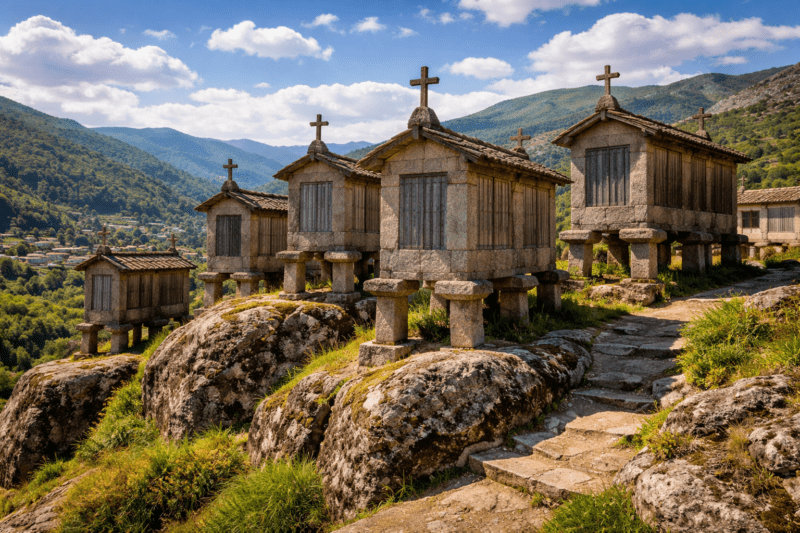
Minho River, Green Heart of the Norte Region
Leaving the granite heights of the Peneda-Gerês, follow the gravity of the mountain springs as they swell into the rivers below. In this stretch of land, the rugged terrain softens into the lush mosaic of the Minho River Valley—the green heart of the Norte Region.
The valley reaches its fullest expression in the northernmost sub-region of Monção e Melgaço. Protected by a ring of mountains, this “amphitheater of granite” has a rare microclimate. Here, the Alvarinho grape develops its renowned mineral complexity. Its distinctive terroir grants the region exclusive rights to the “Alvarinho Monção e Melgaço” designation, widely considered the benchmark. Alongside floral Loureiro and bold Vinhão reds, these citrus-bright wines define Vinho Verde’s rising international prestige.
Wine Estates of Minho
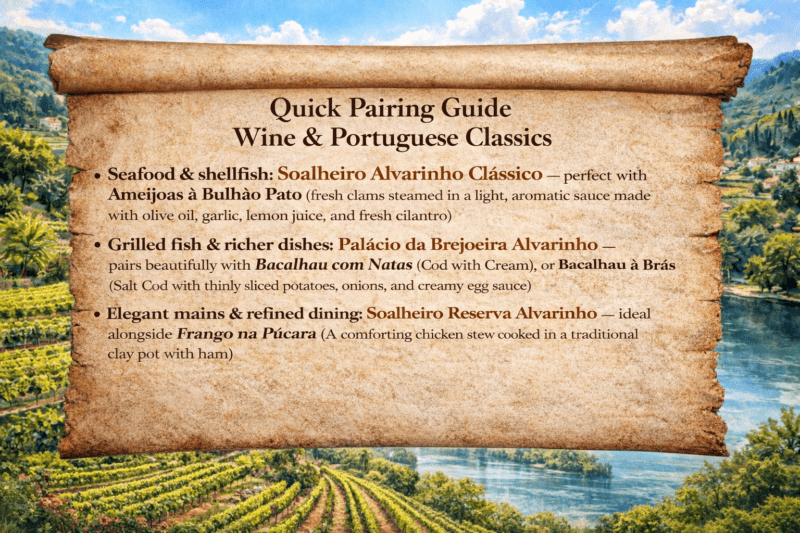
Soalheiro
Soalheiro is the benchmark producer of Alvarinho in the Vinho Verde region, combining critical acclaim and a clear sense of place from Monção e Melgaço. Its wines express premium Portuguese Alvarinho through a balance of innovation and tradition, reflecting modern prestige and deep respect for heritage, with a strong global reputation.
Palácio da Brejoeira
Palácio da Brejoeira is one of the most historic and iconic estates in the Vinho Verde region, renowned for its classic and elegant Alvarinho. Deeply connected to Minho heritage, its wines reflect tradition, authenticity, and a sense of place, capturing the cultural and historical character of the region.
Ancient Bridges & Pilgrimage Roads
Next, our journey takes us from the Minho River toward the Atlantic along the Lima and Cávado valleys. The road leads into a region defined by ancient charters and deep-rooted folk traditions. This stretch of the Camino Português acts as a “sacred vein,” physically and historically linking Ponte de Lima and Barcelos.
Ponte de Lima
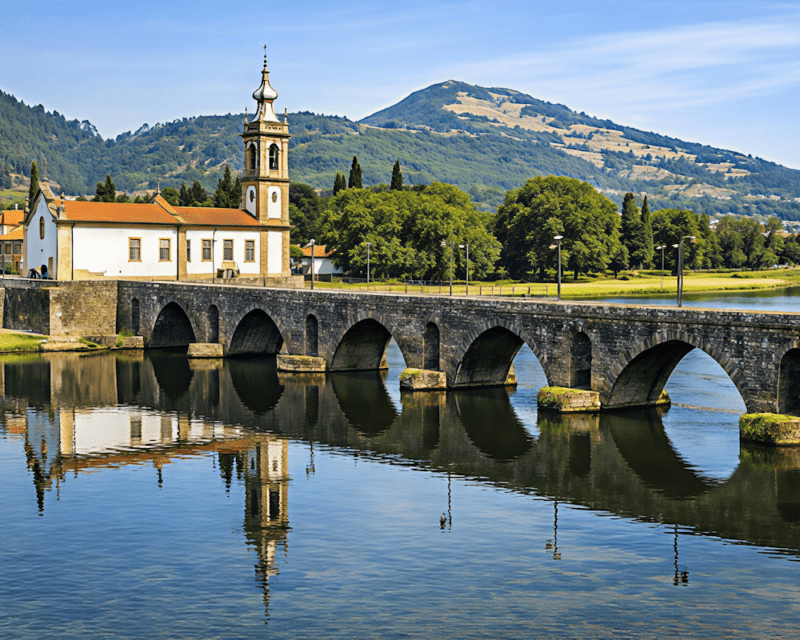
Ponte de Lima, Portugal’s oldest chartered town, traces its origins to Roman times, where it stands on a strategic route linking Braga to Astorga. Granted a royal charter in 1125, the town is an important stop on the Portuguese Central Camino de Santiago, welcoming generations of pilgrims on their journey north. At the heart of the town stands the landmark Ponte Romana. With Roman foundations and medieval extensions, it is one of the oldest bridges in the country. These arches not only span a river—they connect the modern traveler to the same spiritual thread that has pulled pilgrims and kings toward the heart of the Norte for centuries.
The River of Forgetfulness
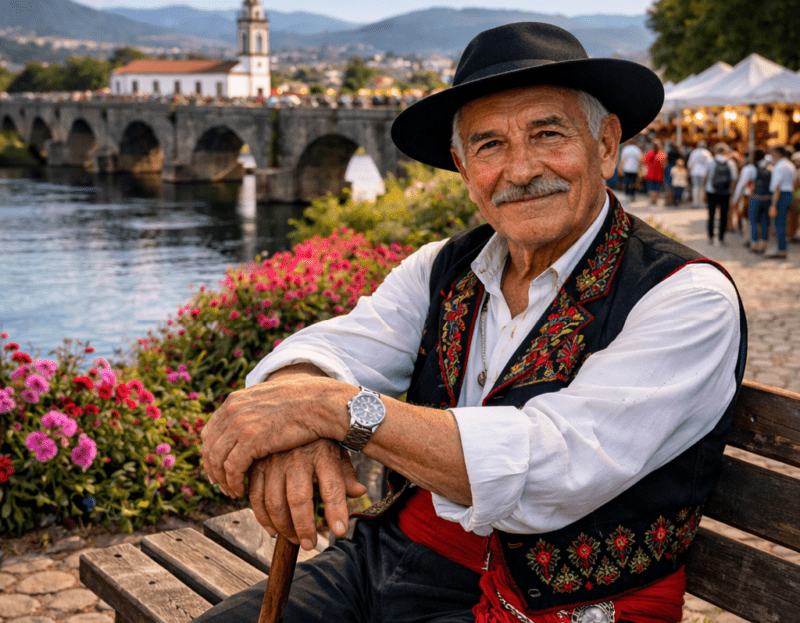
Seated beside the river, I met an elderly local. Beneath the shadow of his wide-brimmed black hat, the man sat—his steady hands, strong and still, resting upon his walking stick. As the sun began to set, the man spoke of his village; his voice was calm and inviting. I was mesmerized by his warm and thoughtful eyes, which held the weight and wisdom of a life well-lived.
His traditional vest was a masterpiece of the Minho region—draped in heavy black wool and brought to life by intricate floral embroidery. Hand-stitched vines of crimson and gold bloomed across his chest, a vibrant map of a heritage he wore with quiet pride.
He recounted the legend of Lethe, the fabled River of Forgetfulness. He spoke about a river that once terrified Roman legions into a frozen silence, fearing they would instantly forget their homeland and every person they had ever loved if they dared to cross its waters. He told me how their commander, Decimus Junius Brutus, finally broke the spell by crossing alone and calling each soldier by name from the far bank to prove his memory was intact.
As he finished the story, he chuckled softly to himself and looked away toward the medieval stone bridge, as if transporting himself to another time and place. Behind him, the market stalls began to glow with a warm, festive light, as if to ward off the very shadows of the past he had just described.
Today in Ponte de Lima, bronze statues of the General and his hesitant army face each other across the water, immortalizing the moment fear turned to courage. Throughout the year, Ponte de Lima comes alive with cultural events that reflect its rich Minho heritage. Spring brings Vinho Verde wine celebrations and floral festivals, while summer features the elegant Feira do Cavalo in July. The town’s most vibrant celebration, Feiras Novas, takes place in September and marks the municipal holiday, filling the streets with parades, folk music, traditional costumes, and fireworks. Leaving Ponte de Lima behind, the landscape begins to open westward, guiding you toward another town where Minho’s traditions step out of legend and into daily life.
Ponte de Lima Highlights
- Ponte Romana Bridge
Walk across the ancient Roman–medieval bridge that has carried travelers, armies, and pilgrims for centuries. - Historic Center
Stroll through flower-lined streets filled with manor houses, tiled façades, and traditional cafés. - Festival Culture
Experience Feiras Novas or the Feira do Cavalo, when the town erupts into music, costumes, and celebration.
Barcelos
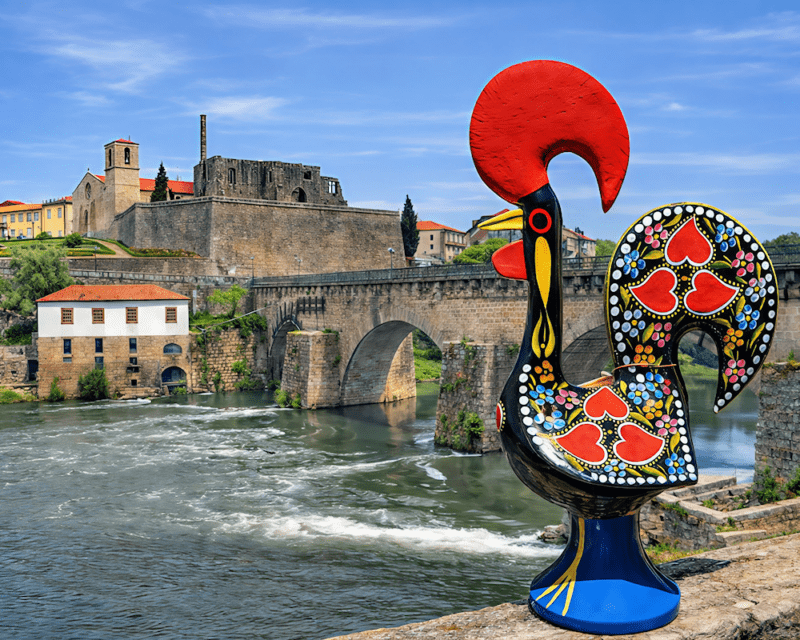
Beneath a five-arched medieval bridge, the Cávado River flows past Barcelos, a city whose folklore remains painted, sculpted, and sold in the streets. Recognized as a UNESCO Creative City, Barcelos stands as the undisputed heart of Portuguese folk art, a place alive with the vibrant colors of its most famous resident, the Rooster of Barcelos, punctuating everyday life.
The Miracle of the Rooster
In the 14th century, a pilgrim bound for Santiago faced a hollow conviction for a crime he did not commit. As the gallows beckoned, he made a final, defiant gesture toward a roasted rooster on the judge’s banquet table.
“My innocence is as certain as the crow of this bird when the rope tightens,” he declared. At the moment of execution, the impossible occurred: the roasted fowl rose to its feet and crowed a piercing song of vindication.
Spared by this divine intervention and a miraculously loosened knot, the pilgrim eventually returned to the city. To honor his life-saving grace, he sculpted the Lord of the Rooster cross, which still stands among the haunting ruins of the Barcelos Archaeological Museum.
If your journey falls on a Thursday, you will witness the Feira de Barcelos, one of Portugal’s largest and oldest open-air markets. Held in the Campo da República, it is a sensory overload of Minho tradition. Stalls overflow with hand-painted ceramics, folk figurines, intricately woven baskets, and local delicacies like cured meats and regional sweets. While a major draw for visitors, the market remains a vital part of local life, where farmers and artisans have gathered for centuries. Leaving Barcelos behind, the air sharpens with salt as the horizon widens, until Minho’s green interior finally gives way to the restless Atlantic.
Barcelos Highlights
- Feira de Barcelos
One of Portugal’s oldest markets, alive with artisans, farmers, and traditional crafts. - Rooster of Barcelos Symbol
Discover the legendary icon that became a national symbol of faith, luck, and justice. - Medieval Bridge & Riverfront
A picturesque setting where folklore and daily life merge along the Cávado River.
Costa Verde − Celtic Myth Meets the Edge of the World
The Costa Verde (Green Coast) stands as a wild, emerald-hued alternative to Portugal’s southern resorts. Inland granite crags dissolve into salty air and expansive, pine-fringed dunes. Beaches like Arda Beach in Afife define this shoreline, offering powerful surf breaks and a raw, uncommercialized beauty that remains one of the country’s best-kept secrets.
Viana do Castelo
Viana do Castelo reveals itself as a tapestry of maritime heritage and architectural grace. From the terrace of the hilltop sanctuary of Santa Luzia, the harbor spreads below, where the hospital ship Gil Eannes rests as a monument to the famed White Fleet of cod vessels that once braved the North Atlantic.
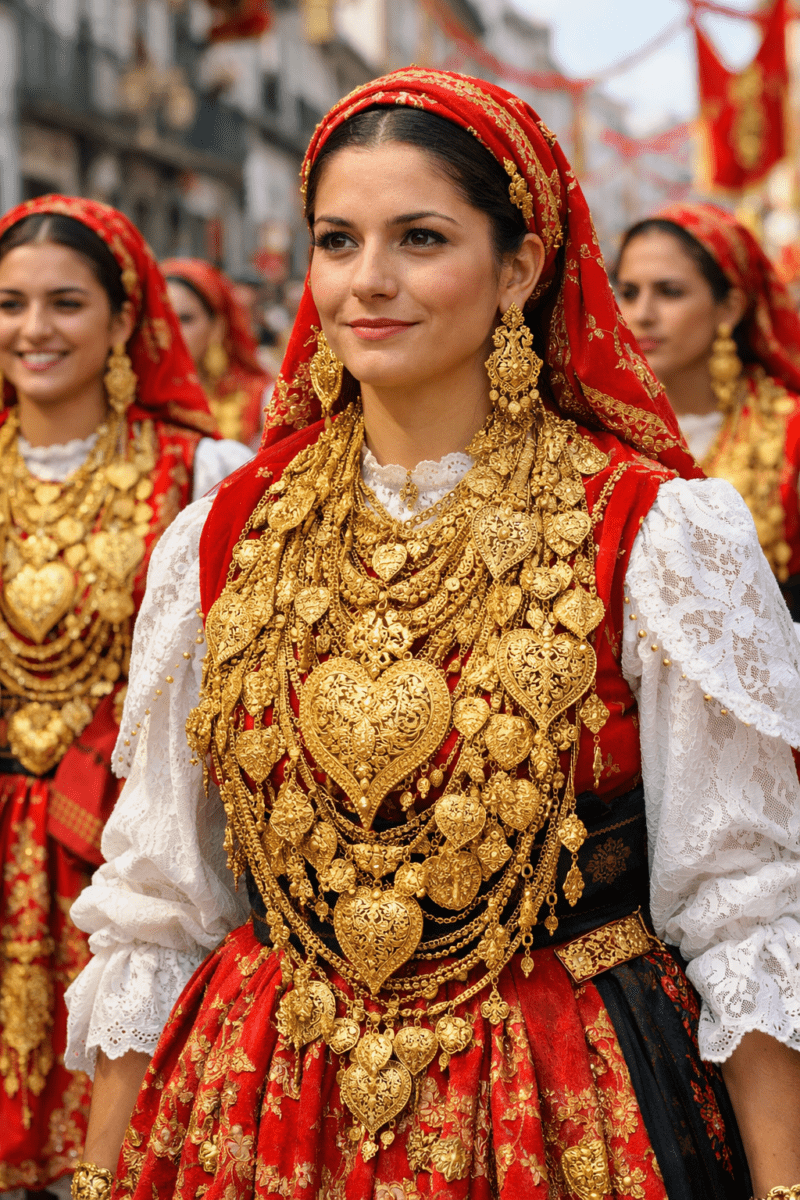
Beyond the harbor, the city’s spirit shines in its gold filigree—the delicate Coração de Viana hearts displayed in shop windows and worn with pride. This craftsmanship reaches its peak during the Romaria de Nossa Senhora d’Agonia in August. Known as the “Queen of Romarias,” this festival transforms the streets into a sea of red and gold as hundreds of women parade in traditional bridal costumes, their chests draped in layers of heirloom gold. These intricate ornaments, light as lace yet forged in precious metal, remain shimmering testaments to an identity as enduring as the ocean itself.
Cape Santo André ─ Viana do Castelo
Along this coast, the wind carries more than salt — it carries stories older than the nation itself. At the heart of this storied shoreline stands Cape Santo André, a landscape steeped in history that predates Portugal. The Celts once believed this was the very edge of the world, a “Port of Souls” where the dead waited in stone cliffside huts for a pagan ferryman to guide them beyond. Romans and later Christians reshaped the legend in the name of Saint Andrew, yet its essence endures: a spiritual sentinel watching over the sea, ensuring every fisherman’s soul finds its way home.
Caminha
Travelling north, the landscape’s quiet dignity lifts into celebration. In Caminha, Artbeerfest transforms the quiet shoreline into a celebration of music, color, and movement. The streets become a global hub of urban art and live music as the sun sinks toward the same horizon that once lured Portuguese caravels into the unknown.
Costa Verde Highlights
- Viana do Castelo — Cultural Jewel of the Coast
A graceful maritime city crowned by the hilltop Santa Luzia sanctuary, celebrated for its filigree heritage, festivals, and sweeping Atlantic views. - Caminha — Borderland Charm
Set where river meets ocean near Spain, this picturesque town blends medieval character with lively summer festivals and waterfront promenades. - Afife Beach — Untamed Atlantic Beauty
A wide stretch of sand framed by dunes and wind-shaped grasses, known for dramatic surf, raw scenery, and a peaceful, unspoiled atmosphere.
The Final Note in a Northern Symphony
From here, the rugged Atlantic coastline turns us southward, completing the circle where the journey began. You have touched the foundations of Portuguese identity and followed the “spiritual thread” of the Camino. You return to Porto not just as a traveler, but as someone who finally understands why the North is the pulse of the nation. The city remains as it has always been: a gateway between the ancient world and the vast Atlantic, holding the keys to Portugal’s past and the quiet strength of its enduring spirit.
As the sun begins to set, head to Jardim do Morro or the upper deck of the Dom Luís I Bridge. Both offer perfect vantage points for reflection. Gazing across the water, the red-tiled roofs of the Gaia Port lodges come into view, historic cellars aging the valley’s famous wines. Below them, the Rabelo boats—once the vital lifelines of the wine trade—bob on the water. The same Douro currents that carved the vineyards of the valley now carry these iconic vessels to rest beneath the city lights, bringing your journey full circle.