Guimarães One-Day Travel Guide
Guimarães is a city that rewards the curious, with layers of time and tradition tucked into hidden corners. Narrow pilgrim alleys, mysterious Templar echoes, and medieval squares reveal the foundations of a nation forged in stone and protected by mountains carved by giants. Between the rugged walls of the fortress below and the weathered granite labyrinths above, Guimarães stands as a living bridge between the raw power of nature and the sacred foundations of history.
09:30 AM | Colina Sagrada: The Birthplace in Stone
A Strategic Path — Parking & Tickets
The journey through Guimarães begins on the Colina Sagrada (Sacred Hill). The landscaped park holds the three most significant monuments of the nation’s founding. The walking path flows naturally from the ancient defensive heights of the Castle, past the humble stone chapel, and down to the grand Palace of the Dukes.
- Arrival & Initial Path
After parking at the public lot off Rua de Dona Mafalda, follow the path from the parking area as it wraps around the castle and opens into the Colina Sagrada park. While the historical story begins at the top of the hill, you will need to purchase tickets at the Palace of the Dukes (Paço dos Duques), which sits at the bottom. By securing your tickets first, you ensure your visit flows chronologically from the 10th-century origins at the peak back down to the 15th-century grandeur of the Palace. - The Ticket Strategy
Head directly to the main entrance of the Palace. Purchase the “Circuit Ticket,” which covers the Palace, the Castle, and the Alberto Sampaio Museum. The same ticket is your “key” to the museum cloisters and the Adarve da Muralha (battlement walkway). Once you have your tickets in hand, don’t enter the Palace rooms yet. Instead, step back outside and follow the same path back to the Castle entrance.
The 10th-century granite fortress stands as the rugged symbol of Portuguese origins, originally commissioned by Countess Mumadona Dias to defend a valley monastery from Viking raids. It evolved from a defensive shield into the political seat of Afonso Henriques, the first king of Portugal. Visitors can walk the battlements for panoramic views and explore the Keep, which houses a museum detailing the castle’s transition from a wooden fort to a Romanesque stone guardian.
As you descend from the heights of the Castle toward the Palace, you will cross the Campo de São Mamede, the historic green expanse situated directly between the two monuments. This “hallowed ground” is far more than a park.
It is traditionally believed to be the site of the pivotal Battle of São Mamede in 1128, where Afonso Henriques defeated his mother’s forces to effectively birth the Portuguese nation. Walking across this field places you in the literal center of the country’s origin story, offering a stunning perspective of the Castle’s jagged silhouette as it has loomed over this battlefield for nearly a thousand years.
Set between the Castle and the Palace, this humble 12th-century granite chapel is considered the “sacred square footage” where Afonso Henriques was baptized. The interior is characterized by its austerity, featuring a floor of irregular stone slabs that serve as graves for the warrior-nobles who fought for the early monarchy. The simple, chalice-shaped stone baptismal font remains the centerpiece — a plain yet powerful vessel that traditionally held the water for the first king’s baptism, marking the modest start of a future global empire.
The Palace of the Dukes of Bragança marks a leap of nearly 300 years in Portuguese history — from the rugged age of Afonso Henriques, the warrior king who founded Portugal, to an era of power, wealth, and global ambition. Built in the 15th century by Afonso, 1st Duke of Bragança, the palace symbolized the rise of the influential House of Bragança, the royal branch that would eventually claim Portugal’s throne in 1640 and rule a vast empire stretching from Brazil to India until the monarchy ended in 1910.
The palace itself reflects this moment of confidence and expansion, with its striking forest of 39 chimneys, colorful Flemish stained glass, ship-hull wooden ceilings inspired by the caravels of the Age of Discovery, and the famous Pastrana Tapestries depicting Portugal’s conquest of North Africa.

The Palace of the Dukes lifted the elite to new heights of prestige and power.
11:30 AM | Rua de Santa Maria
From Sacred Hill to Stone Street
Leaving the wooded calm of the Colina Sagrada behind, the mood shifts almost immediately. At the park’s edge, the wide gravel path narrows, funneling into the slender stretch of Santa Maria Street. This walk follows the historical spine of the city, transitioning from the foundational 10th-century castle district to the 14th-century civic heart.
In the 10th century, Countess Mumadona Dias commissioned this protected passage to connect her castle with the monastery below — a strategic link in uncertain times. Over the centuries, the defensive route evolved into a formal street of granite, paved and strengthened as Guimarães grew in stature and confidence.
Today, the street carries that layered history openly. Gothic and Baroque façades rise shoulder to shoulder, their granite walls softened by wrought-iron balconies overflowing with flowers. The buildings lean slightly inward, casting cool shadows across worn cobblestones polished by centuries of footsteps. Massive granite thresholds frame many doorways — medieval statements of status carved from single blocks, their scale quietly declaring wealth and influence. Above them, coats of arms (brasões) are etched into the stone, some intact, marking lineages that endured, while others are fractured — subtle reminders that prominence is never guaranteed.
Convent Traditions and Architectural Ambition
About halfway down Santa Maria Street, the presence of the Antigo Convento de Santa Clara draws the eye upward. Once among the wealthiest convents in the region, it was here that cloistered nuns perfected Guimarães’ celebrated egg-yolk sweets. Egg whites are used to starch habits and clarify wine, leaving an abundance of yolks behind. Rather than waste them, the sisters transform them into rich confections of sugar and gold — a culinary tradition that survives long after the convent’s cloistered days. The street narrows here. Stone feels close.
Continuing downhill, the most striking feature comes into view: the arch of Casa do Arco, spanning from one side of the lane to the other. One side of the residence rises larger and more substantial, generally understood to be the original medieval home of a noble urban family. Across the narrow street, a later wing extends the property as the family expanded. With little room to grow, the two structures are joined by a stone arch — a practical solution that became one of the city’s most recognizable images.
Pastries and the Arrival at Largo da Oliveira
Just beyond the arch, almost easy to miss, sits Pastelaria Clarinha (Divina Gula). Inside, glass cases display Tortas de Guimarães — handmade sweets filled with chila (squash jam), almonds, and eggs, rooted in convent tradition. Pausing for a galão (coffee with milk) and one of the city’s signature pastries, you taste the richness of egg yolk and almond echoing the story traced through stone.
A few steps farther, the buildings begin to recede and light widens overhead. Santa Maria Street opens into the broad expanse of Largo da Oliveira. Arcades frame the square, stone monuments anchor its center, and cafés spill into the open air. After the intimacy of the narrow lane, the space feels expansive and alive — a place where history no longer leans overhead but stands fully revealed.
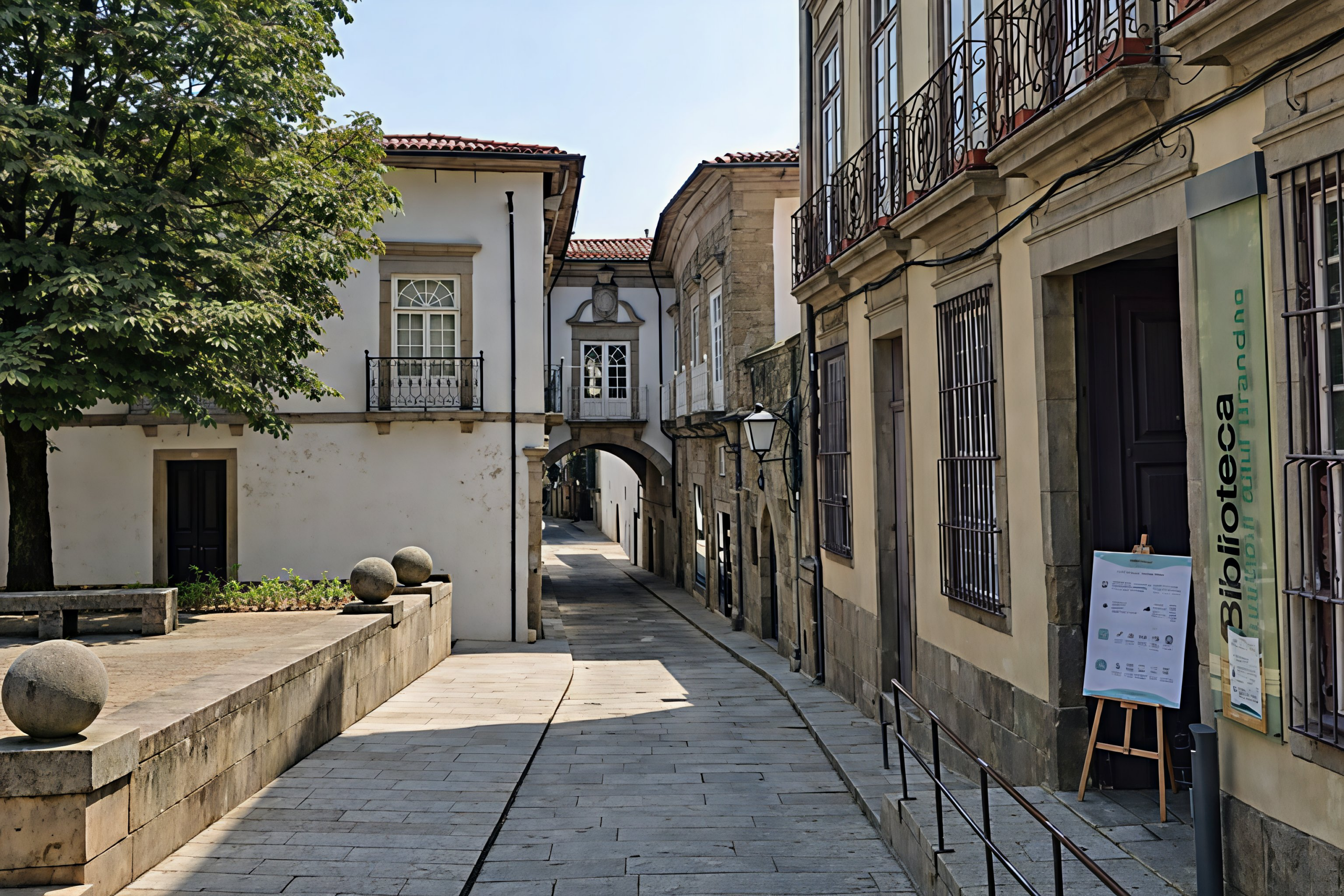
Casa do Arco’s stone arch links two wings of a medieval noble residence.
12:15 PM | Largo da Oliveira & Praça de São Tiago
The City’s Heart
At the end of Rua de Santa Maria, you enter a sequence of interconnected squares that form the communal heart of the city, where the historical narrative shifts from monarchy to people. Largo da Oliveira and Praça de São Tiago serve as Guimarães’ open-air living room, surrounded by 14th-century architecture and wrought-iron balconies. Although the physical walk through all three takes only about four to five minutes, the transition feels like a leisurely movement through a grand outdoor gallery.
In Largo da Oliveira, an olive tree growing from a stone planter recalls a legend that gave the square its name. According to the story, a dead olive tree miraculously sprouted new leaves after a merchant named Pero Esteves placed a granite cross beside it, turning the square into a site of divine favor. King Afonso IV later built the Padrão do Salado over the cross to commemorate his victory at the Battle of Río Salado, linking royal triumph with a miracle remembered by the people.
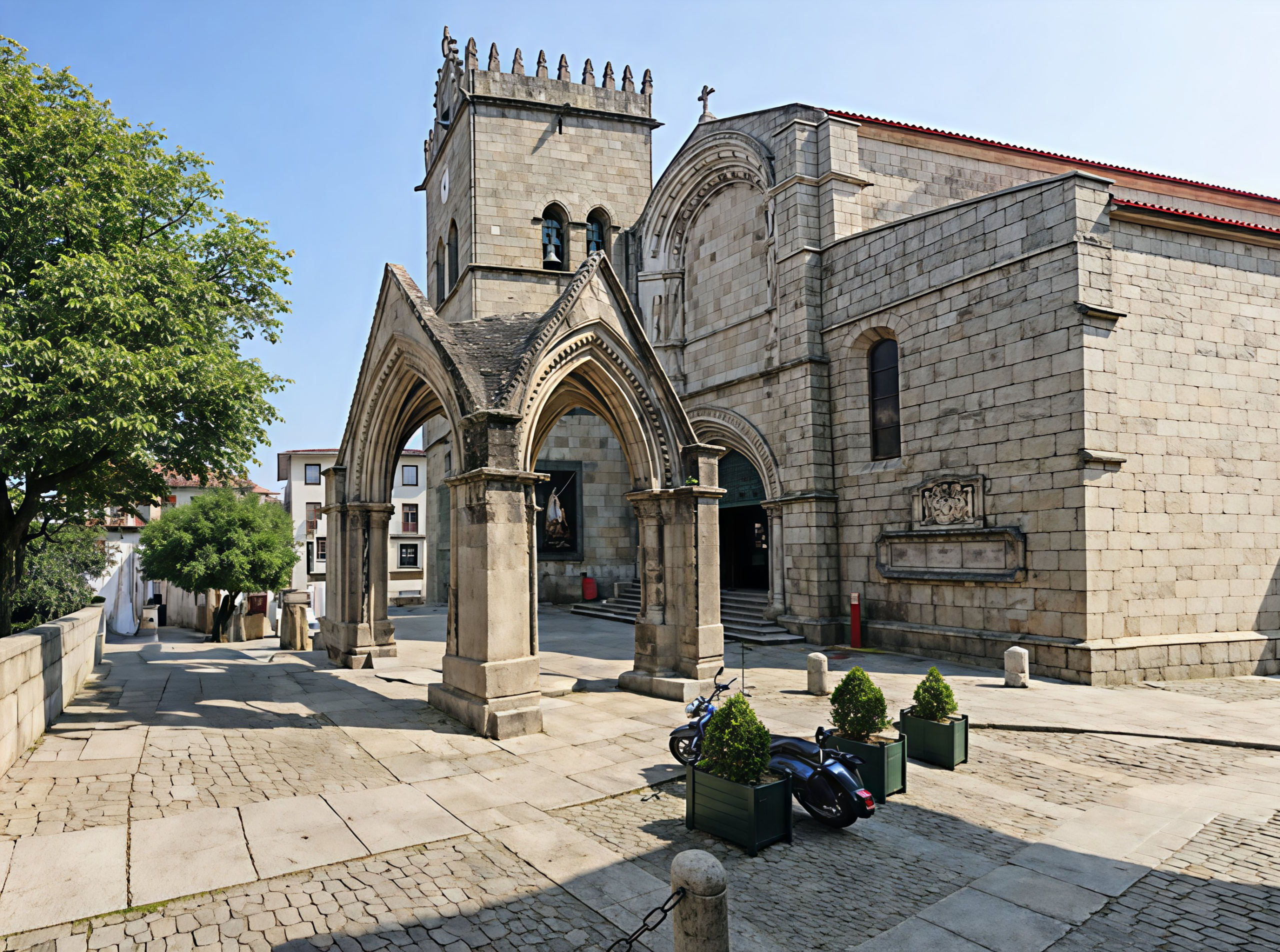
Padrão do Salado beside the Igreja de Nossa Senhora da Oliveira.
The Church of Nossa Senhora da Oliveira began in 949 as a monastery founded by Countess Mumadona Dias. In 1139, Afonso Henriques transformed it into a church, preserving part of the original foundation as a visible link to the city’s earliest history. After the victory at the Battle of Aljubarrota, King João I rebuilt it into the Gothic structure seen today, which houses treasures such as the Silver Altar, an ornate pipe organ, and the historic cloister garden.
Museu de Alberto Sampaio & Adarve da Muralha (Patrol Path)
From the spiritual heart of Igreja da Oliveira, a side door leads into the Museu de Alberto Sampaio. You transition from the dim nave into sun-drenched Romanesque cloisters, where the church’s treasures are preserved.
Adarve da Muralha
The Adarve da Muralha is the protected walkway atop a fortification, historically used by guards to patrol between towers.
- Take a staircase within the museum complex — a brief vertical climb of about two flights. Once atop the wall, the stone path is flat and offers an iconic view down the floral promenade of Campo da Feira to the twin spires of Santos Passos. Look for the perfect symmetry of the eighteenth-century gardens below and the silhouette of Mount Penha in the distance.
- After taking in the panoramic views, simply pivot and descend the same stairs to return to the cloisters. This keeps you within the medieval core, ready to step through the arches into Praça de São Tiago.
Passing through the arches of the Old City Hall leads into Praça de São Tiago, a historic square shaped by both legend and later urban development. Local tradition claims that Saint James once placed an image of the Virgin Mary here, linking the site to early Christian devotion and the wider Camino de Santiago pilgrimage. Although the square itself formed centuries later and the Chapel of Saint James was eventually demolished, its footprint remains in the paving stones, preserving the space’s spiritual legacy.
1:00 PM | Largo do Toural & the Leather District
Largo do Toural began as a muddy field outside the medieval walls where cattle fairs and early bullfighting took place. In the 18th century, after the city walls were demolished by order of Queen Maria I, the area was transformed into an organized civic square lined with elegant façades. Today it serves as a lively gateway to the historic center, surrounded by landmarks such as the Basilica of St. Peter and the Torre da Alfândega, and hosts major celebrations like the Festas Gualterianas.
Cash Alert
Before leaving Largo do Toural behind, make sure to visit an ATM if you are low on cash. Monte da Penha is a world of granite and tradition that extends to their payment methods. There are no ATMs on the mountain, and many of the local spots remain strictly cash-only. Look for the Multibanco (MB) logo. It is the gold standard for banking in Portugal. These machines are usually built into the walls of major bank branches. Pro-Tip: If the machine asks to “Convert” your currency, always decline. Let your home bank handle the exchange rate in euros to save roughly 10% in hidden fees.
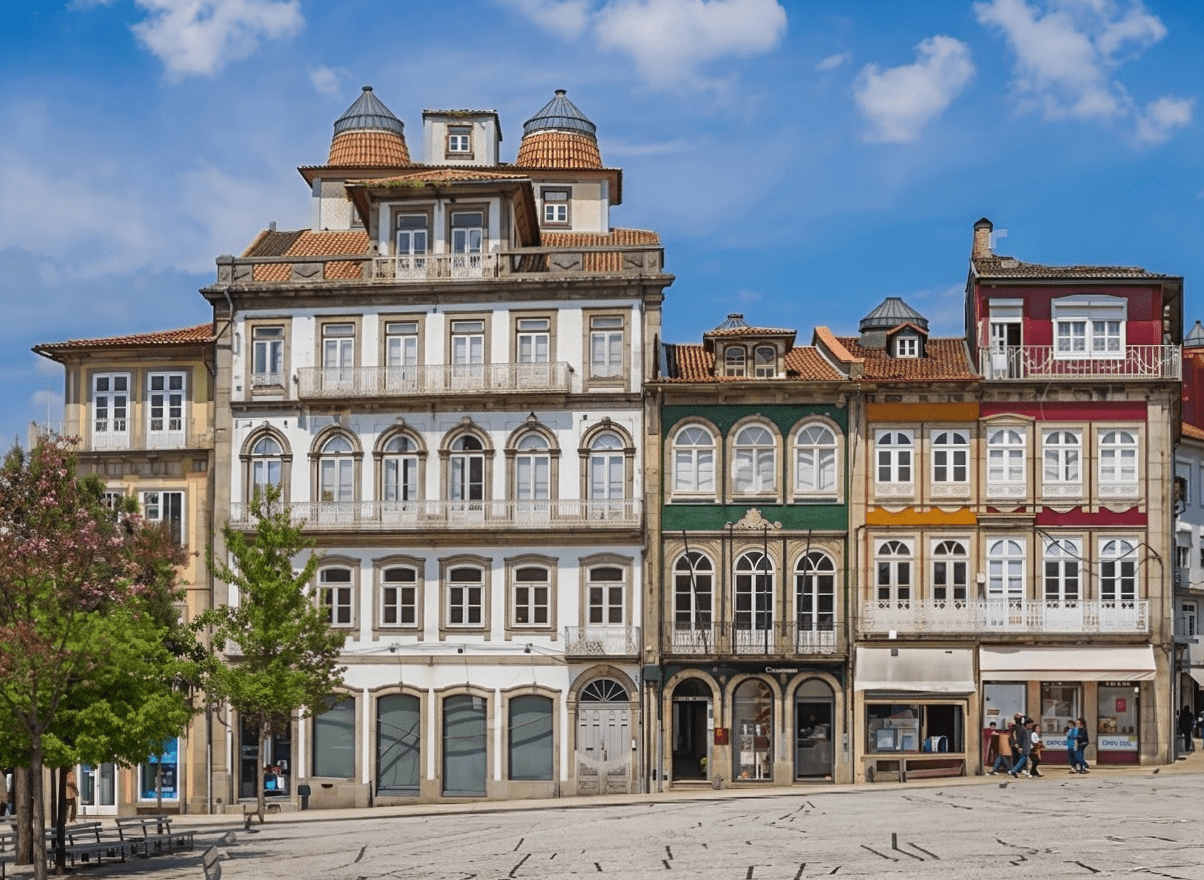
Elegant Pombaline façades frame Largo do Toural.
From Largo do Toural, the Alameda de São Dámaso Garden leads downhill into the Zona de Couros, Guimarães’ historic Leather District. The industry flourished here thanks to three key resources: water from the Couros River, tannin-rich oak bark from nearby forests, and a steady supply of animal hides from the cattle market at Toural. For centuries this hillside operated like a vertical production line — livestock sold above, hides processed below — until pollution, industrial change, and synthetic materials led to the decline of the tanneries in the 20th century.
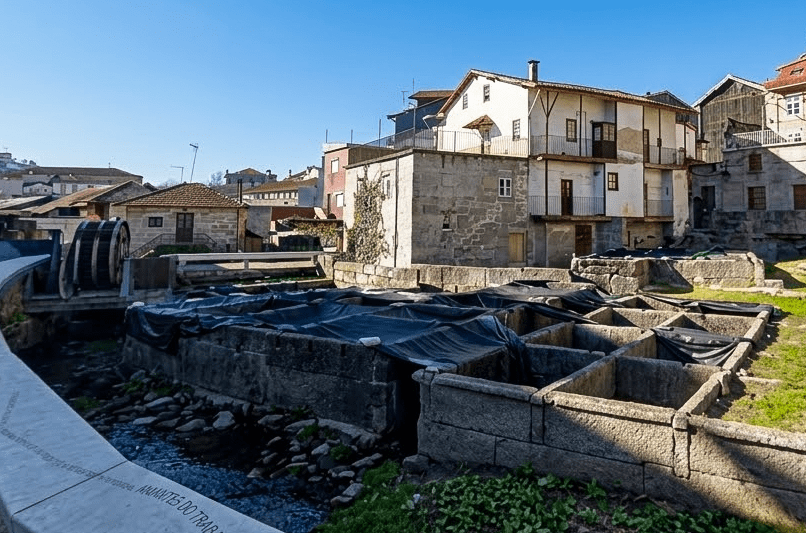
Tanning pits — a grid of ancient stone tanks once used for soaking animal hides in tannins.
The Ascent: The Franciscan Sentinel
From Largo da Cidade, Rua de São Francisco climbs back toward the Alameda Garden. To the left stands a monumental architectural trio marking the boundary between labor below and devotion above.
-
Igreja de São Francisco: A granite Gothic structure representing the city’s medieval foundations, with pointed arches and a Manueline portal dating to the 1400s.
-
Venerável Ordem Terceira: Wrapped in blue-and-white azulejos in the 19th century to protect it from northern rain, a practical solution that became one of the city’s most distinctive façades.
-
The Convent and Cloisters: Extending from the church, the long wing reveals the scale of the Franciscan community that once lived here, overlooking the tanning district and bridging the city’s spiritual and industrial life.
01:45 PM | The Promenade: Campo da Feira & Santos Passos
Leaving the Franciscan complex and the Cruzeiro of São Francisco behind, a wide, symmetrical embrace of color and stone comes into view. Before you stretches Campo da Feira, now an expansive formal garden designed not simply as green space but as theater. It forms a grand floral avenue arranged so that every hedge, fountain, and bed of seasonal blooms draws the gaze forward. At the end rises the Church of Santos Passos, its twin towers lifting into the northern sky, with Mount da Penha beyond. This is one of the most iconic and photographed views in Guimarães.
Jardim da República do Brasil, once known as Campo da Feira — the fairground — hosted markets, festivals, and civic gatherings for centuries before its transformation. In the late nineteenth century, the open fairground became a formal Romantic-style garden. Carefully plotted flowerbeds spread like embroidery across the earth, reflecting the city’s desire for refinement and modern European design. The space divides into upper and lower gardens — both sharing disciplined geometry and seasonal reinvention.
Campo da Feira remains ceremonial and social, where locals pause on shaded benches while cafés and shops line the perimeter beyond the old city walls. In spring and summer, blooms shift the palette weekly. In early August, during the Festas Gualterianas, celebrated since 1906, the garden becomes the illuminated heart of parades, concerts, and celebration. For the perfect symmetrical view, stand at the far end near the courthouse, where clipped hedges frame the fountains that lead the eye toward the twin spires of Santos Passos rising perfectly centered beyond.
The garden serves as a processional path to the Church of Santos Passos, completing the composition. Construction was completed in 1785, though the now-iconic bell towers followed nearly a century later. Its Baroque façade curves with restrained drama. Slender towers rise on either side, clad in traditional blue-and-white azulejo tiles that shimmer in shifting light. Granite carvings frame doors and windows with deliberate ornament.
If the doors are open, the interior reveals gilded woodwork and classic Portuguese ceramic artistry — gold leaf catching candlelight, devotional imagery layered in depth and texture. The attached oratórios — small chapels built for the Passos da Paixão (Stations of the Cross) — play a central role in religious processions, allowing faith to move through the space physically and ritually.
Teleférico da Penha
From the blue-and-white tiles of the church, a short, five-minute walk through the lower gardens leads directly to the Teleférico station. This 1.7km cable car ascent serves as a ten-minute transition between the refined Baroque streets below and the raw, ancient granite that guards the city from above.
Before you begin the climb, check the official Teleférico website for the current seasonal operating hours to ensure you don’t miss the final descent.
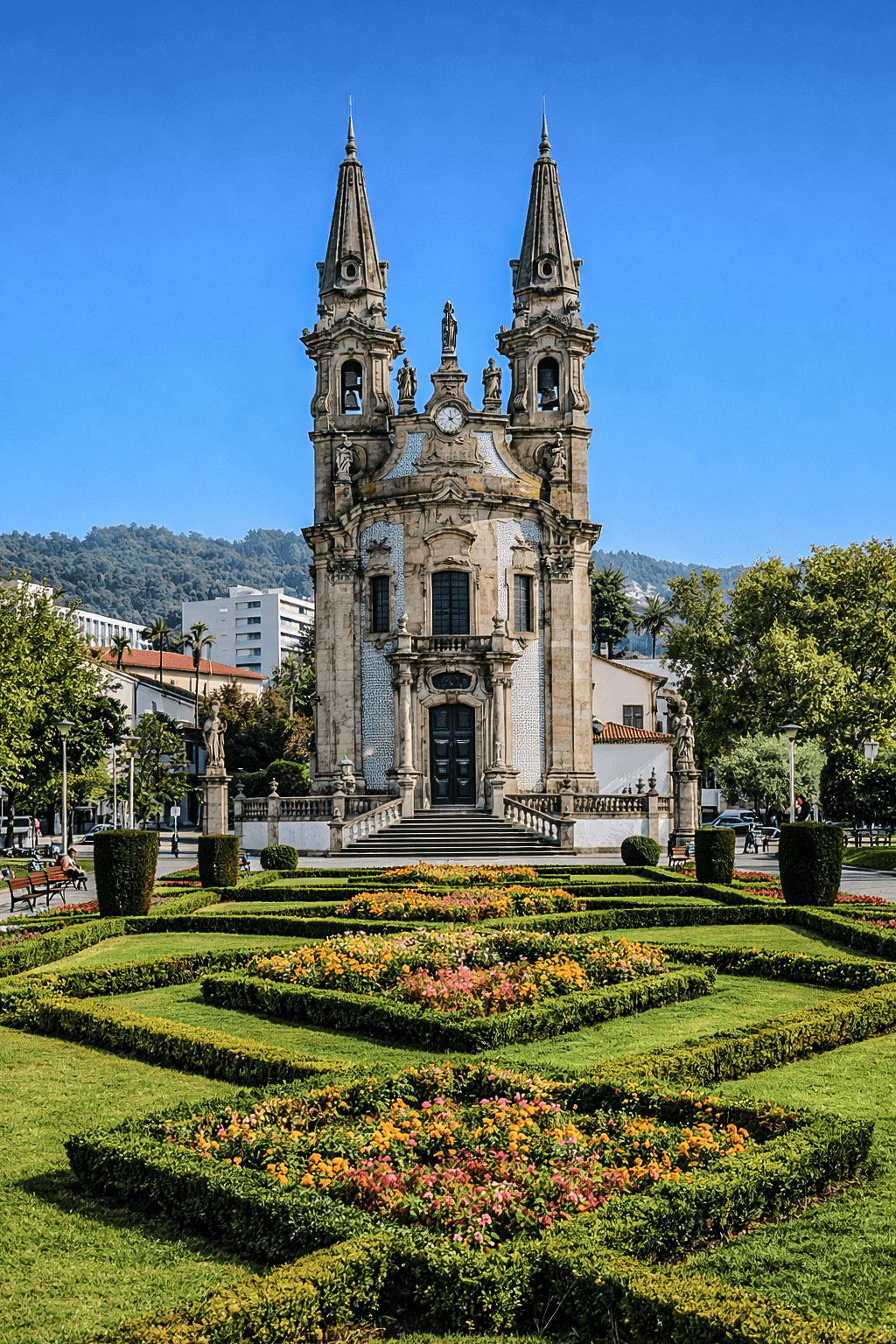
Campo da Feira promenade beckons toward dramatic Santos Passos.
02:15 PM | Penha: The Rocks Tell Their Story
A day in Guimarães — and far too much to see. With only one chance to explore the birthplace of Portugal, every hour matters. At first glance, Monte da Penha didn’t make the cut. Guimarães is already filled with historic churches I planned to visit. Did I really want to spend three precious hours for another altar and a stroll around the summit? To make every hour count and ensure you don’t miss the soul of the mountain, this figure-eight itinerary is the most efficient way to use our time.
The First Loop: Ancient Foundations
Monte da Penha is far more than a church — it is a landscape of weathered granite. If the rocks of Penha could speak, they would tell a story of time, faith, and the people who walked among them. For centuries, erosion carved the massive boulders into a maze of formations, their crevices and granitic tafoni offering shelter to early inhabitants. As settlements grew in the valley below, the granite heights of Penha remained a natural vantage point.
- Pope Pius IX: The 1893 marble statue commemorates his 1854 proclamation of the Dogma of the Immaculate Conception. That decree ignited a surge in Marian devotion, helping transform Penha into a major pilgrimage site. The monument bridges ancient stone worship with modern Catholic faith.
- Capela de Santa Catarina: Built in 1601, this is the oldest surviving chapel on the mountain. It was erected in honor of Saint Catherine of Alexandria at a time when the mountain was used by hunting parties. Its simple stone walls reflect Penha’s transition from an ancient watchpoint into a place of Christian prayer. The chapel is almost always closed, though viewings can be arranged at the administrative Office of the Brotherhood of Penha.
- Mitre Rock: Named for its resemblance to a bishop’s headpiece, Mitre Rock is a masterclass in the slow art of geology. Water, the silent architect, seeps into the granite’s pores to chemically dissolve minerals into clay. Wind then scours out this weakened core, leaving the hollowed “tafoni” structure that mirrors the religious symbols of the pilgrims below.
- Gruta de Nossa Senhora de Lourdes: A grotto dedicated to the Virgin Mary. It represents the universal theme of sacred healing, and celebrates the idea that peace and restoration can be found in the earth’s most humble, shadowed corners.
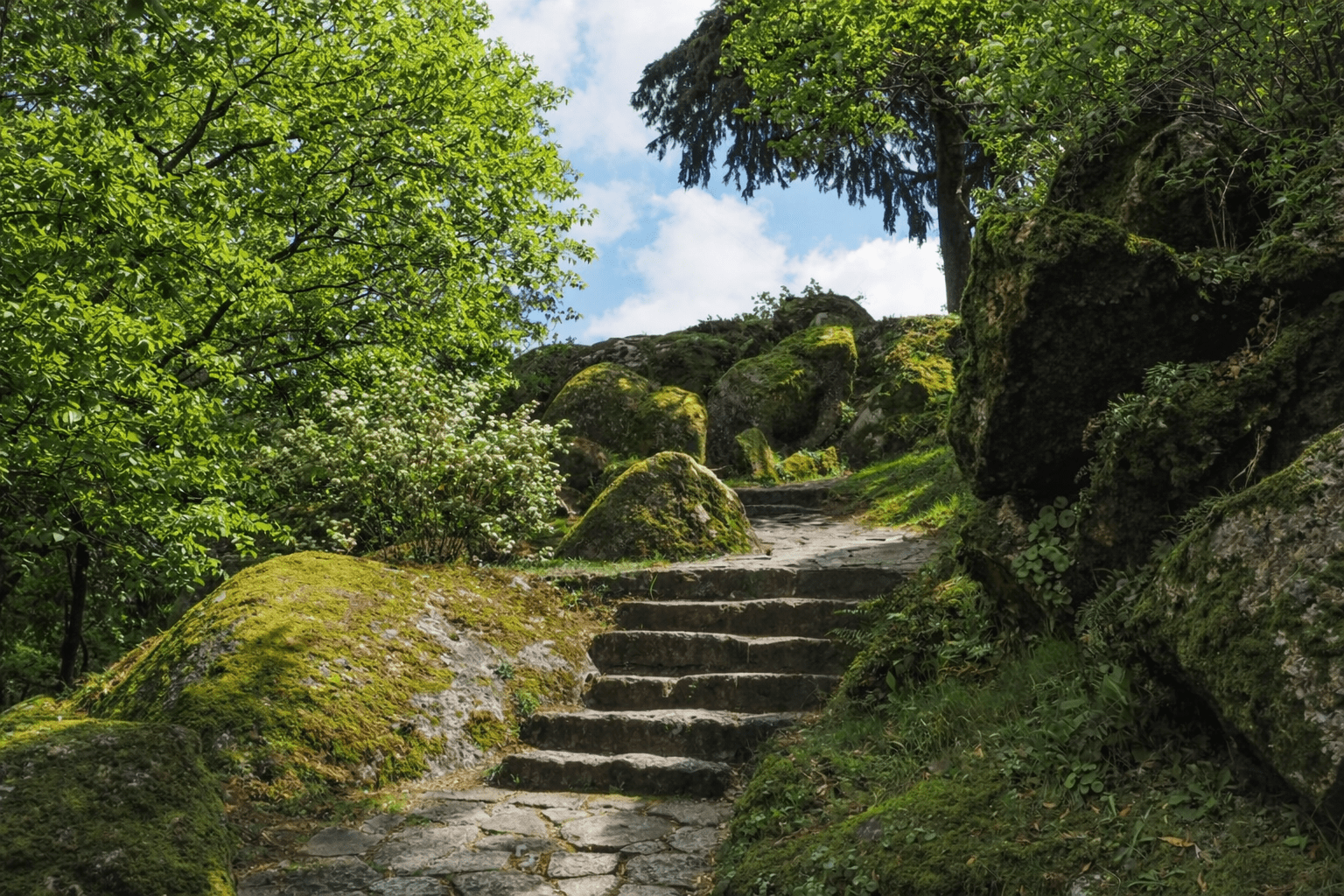
Granite steps leading into the mysterious labyrinth.
The Second Loop: The Hermit’s Path
Gradually, Monte da Penha became a place of pilgrimage and devotion. Hermits such as Guilherme Marino sought solitude among the granite grottoes, while pilgrims climbed the mountain in search of reflection. Today the mountain is both a religious destination and a natural park overlooking Guimarães, reached by car, forest trails with scenic viewpoints, or the Penha cable car (Portugal’s first cable car, operating since 1995).
- Adega do Ermitão: Built directly into the rocks, the “Hermit’s Cellar” uses natural stone insulation to store wine and food at steady temperatures—a reminder that hermits once lived among these hills, not just passed through them. Today, it feels more like a relaxed barbecue in the park, making it an ideal pause before continuing on.
The chicken and ribs are tender and lightly charred, with the deep, smoky flavor of wood fire. Served with couve salteada (sautéed cabbage) and warm pieces of bola de forno, the meal is simple, rustic, and deeply satisfying. Vinho verde is poured into white malgas (bowls)—cool, lightly sparkling, and bright enough to cut through the richness of the barbecue. Note: cash only (euros).
- The Serpent & the Labyrinth: A prehistoric maze of narrow granite corridors where towering stone walls create a cool, mossy sanctuary. The winding paths, like a serpent, slither through the massive boulders, hiding secret grottos and ancient hermit shelters at every turn.
- Gruta-Ermida de Nossa Senhora do Carmo: Literally carved into the granite, this small chapel was the original sanctuary of Guilherme Marino, a hermit who arrived from Rome in 1702. By choosing this “lapa” (natural hollow), he transformed the mountain’s raw geology into a living altar. Inside the dim, cool cave, the unpolished stone walls still house the 18th-century sculpture of the Virgin Mary that he commissioned from a craftsman in Braga. To the right of the altar in the main cave, a literal crack opens in the massive granite boulders. This claustrophobic, natural stone shelf is where Guilherme Marino is said to have slept for nearly 30 years.
- Capela de São Cristóvão: Perched high on granite outcrops, the Capela de São Cristóvão serves as a symbolic guardian for pilgrims navigating the mountain’s difficult “Serpent” paths. This simple stone structure, built to withstand high-altitude winds, offers a panoramic view of the valley and acts as a protector for the road ahead. The Chapel of Saint Christopher is the final spiritual marker on this loop before we head toward the summit’s grand finale.
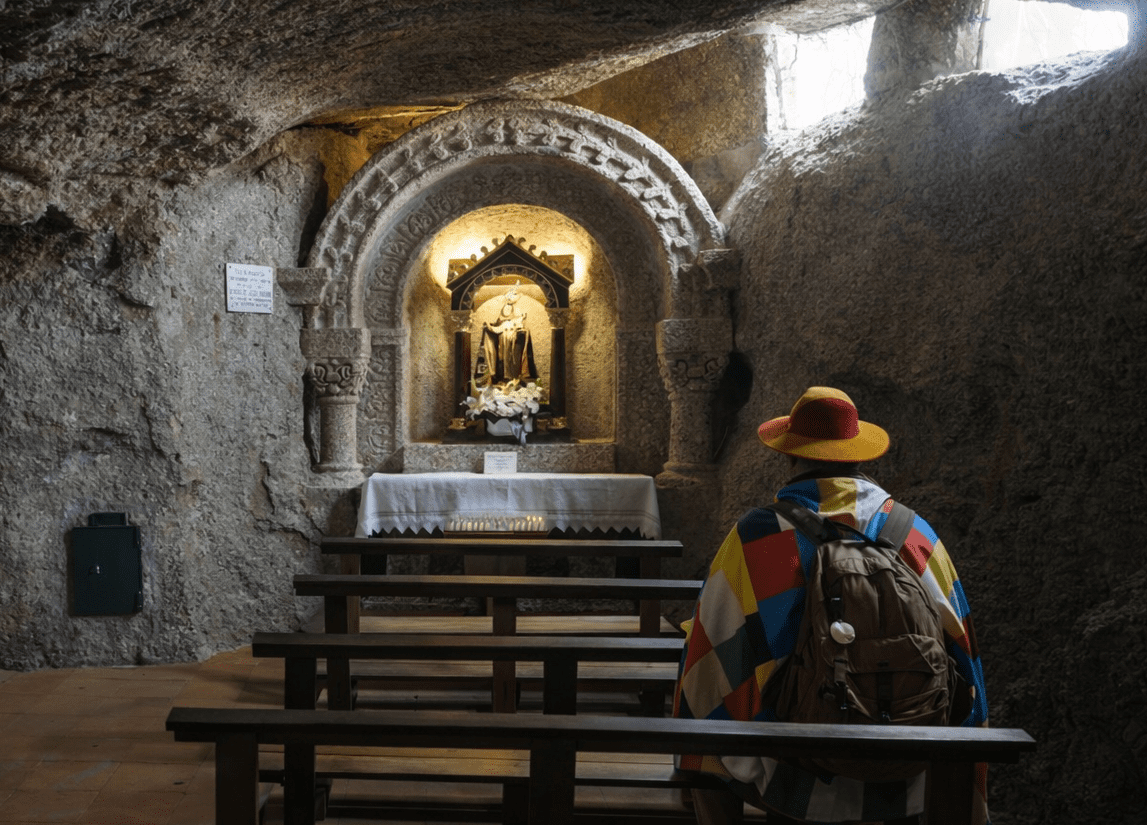
Pilgrim reflecting on those who have come before.
The Grand Finale
We finish our walk by visiting the most famous landmarks that define the Penha skyline today.
- Hotel da Penha / Monastery: Historically associated with the Augustinian order, this complex now survives as a distinctive historic hotel. It anchors the mountain’s long history of hospitality, transitioning from a place of monastic refuge to a landmark of modern tourism while preserving its majestic stone character.
- Aviators’ Monument & the Wobbling Boulder: These quirky landmarks prove that the rocks remain the defining feature of the landscape. The Aviators’ Monument, shaped like the tail of a plane, pays tribute to the pioneers of flight, while the wobbling boulder reminds visitors that even the most massive granite can appear playful and precariously balanced.
- Sanctuary of Penha: Designed by the renowned architect José Marques da Silva, this Art Deco masterpiece is built from the same granite as the mountain itself. It seems to rise naturally from the surrounding rock, serving as a soaring crowning achievement that blends religious grandeur with the raw, jagged peaks of the landscape.